



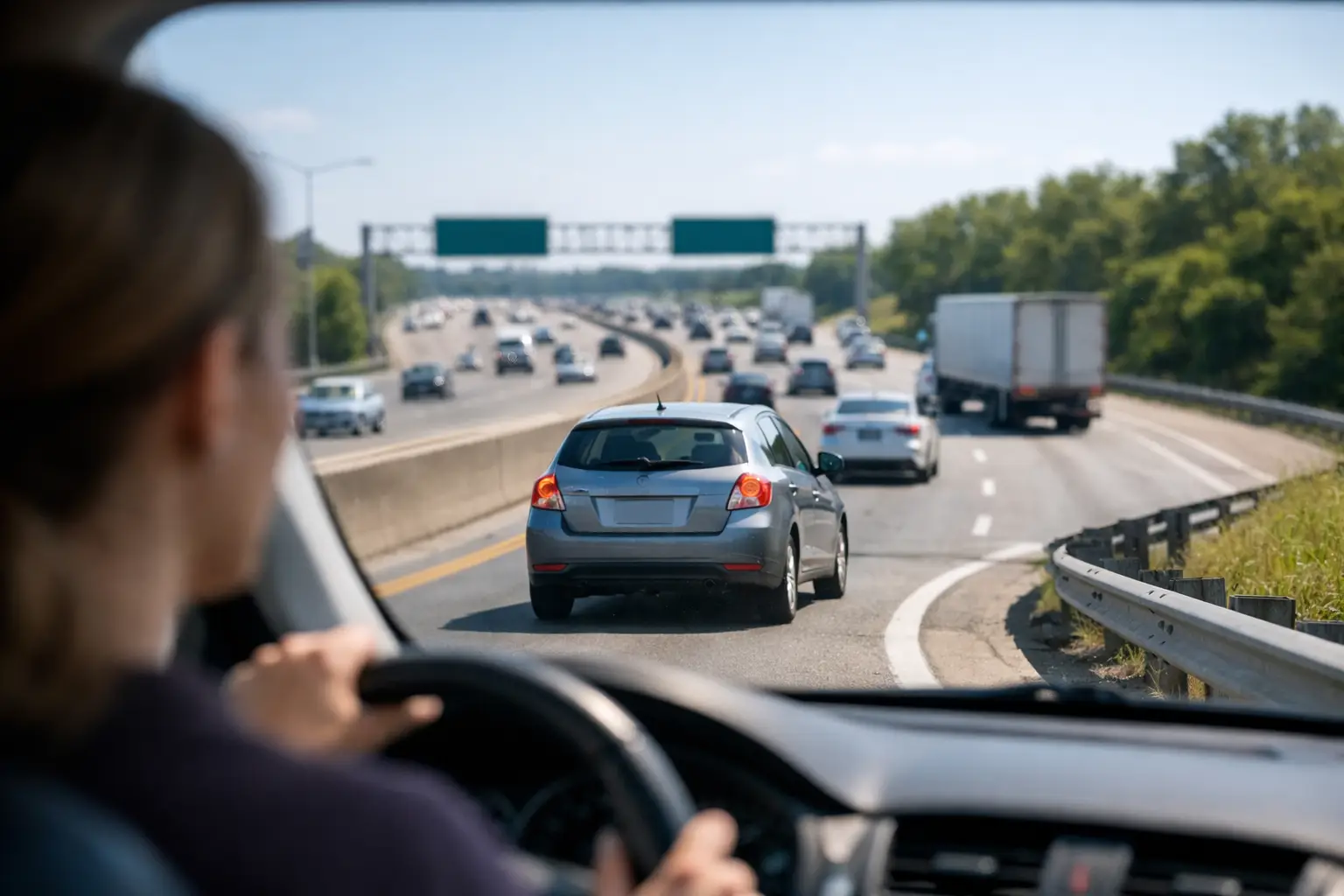
The hardest part of a highway merge often happens before the ramp ends: you see fast-moving traffic, your hands tighten on the wheel, and it feels as though every vehicle is closing the gap. Merging onto highway lessons for nervous drivers should replace that pressure with a repeatable process. You are not trying to force your way into traffic. You are building the right speed, reading space early, and making one controlled decision.
A confident merge is not about being aggressive. It is about being predictable. Drivers already on the highway need to be able to anticipate what you will do, while you need enough time and space to enter without making anyone brake suddenly. That is a skill that improves with structured practice.
What a Highway Merge Is Really Asking You to Do
An entrance ramp gives you a transition area between lower-speed roads and highway traffic. Your job is to use that space to assess conditions, accelerate toward the speed of traffic, choose a suitable gap, and enter the right lane smoothly.
The key word is transition. Do not treat the ramp as a place to stop and wait for a perfect opening. In most situations, the acceleration lane is there so you can gain speed before joining traffic. Vehicles moving at similar speeds need less space between them than vehicles moving at very different speeds.
This is why merging can feel difficult for nervous drivers. It requires several tasks at once: steering through a curve, checking mirrors, scanning traffic, controlling speed, signaling, and looking over your shoulder. The solution is not to rush those tasks. It is to perform them in the same order every time until the sequence becomes familiar.
Merging Onto Highway Lessons for Nervous Drivers: The Sequence
Start preparing as soon as you enter the ramp. Look ahead through the curve, but begin checking the highway traffic pattern early. A quick mirror check tells you what is approaching behind. A look toward the highway tells you whether traffic is moving freely, bunching up, or leaving usable spaces.
As the ramp straightens, accelerate firmly and smoothly. Hesitation is a common problem because nervous drivers fear going too fast. Yet entering at a much lower speed than highway traffic can create a greater risk. Your goal is usually to approach the flow of traffic, subject to posted limits, ramp conditions, weather, and available space.
Signal before you intend to move into the highway lane. Then check your side mirror and perform a shoulder check toward the lane you are entering. Mirrors help you monitor traffic, but they do not show every vehicle beside your car. The shoulder check confirms that the space is actually clear.
Next, select a gap. Many new drivers focus only on the car directly beside them. Instead, look at the space between vehicles. Ask yourself whether you can enter behind one vehicle and ahead of another without either driver needing to react sharply. A useful gap is one that lets you settle into the lane at a similar speed, not one that requires immediate hard braking.
Once you have chosen the gap, commit to it. Maintain your acceleration as needed, make a smooth steering movement into the lane, and center your vehicle. Cancel the signal after the merge and return your focus well ahead. Do not keep looking sideways after you have entered. Your attention belongs on the traffic in front of you.
Look for Space Ahead, Not Just Beside You
A merge becomes easier when you stop searching for an empty highway and start reading the pattern of traffic. On a busy road, there may be no completely open lane. There are still spaces between vehicles, and one may be large enough for a safe entry.
Look several vehicles ahead rather than locking your eyes on the closest car. Notice whether a driver in the right lane is gaining on another vehicle, slowing slightly, or maintaining a steady position. These movements help you predict where a gap will be when you reach the end of the ramp.
For example, if a vehicle is slightly ahead of your position and another is farther behind, easing into the space behind the first vehicle may be safer than trying to accelerate ahead of it. If the gap is closing, you may need to adjust your speed and choose the next opening. The best choice depends on traffic speed, ramp length, and how quickly conditions are changing.
Avoid matching your speed exactly with a vehicle beside you for too long. That puts you in a blind-spot position and leaves you with fewer options. Adjust slightly, either by easing off or accelerating, so you can move into a clear space.
Why Stopping on the Ramp Can Make Things Harder
Stopping at the end of an entrance ramp is sometimes necessary. Heavy congestion, a short ramp, a yield sign, or an obstruction may leave no safe alternative. If you must stop, do so with control and leave enough room to accelerate again.
But stopping when there is a usable acceleration lane often makes the next decision more difficult. You now have to accelerate from zero while highway traffic continues at full speed. This reduces your time to join and can surprise drivers behind you on the ramp.
Use the ramp length available to you. If traffic is light or moderate, build speed early and merge smoothly. If traffic is dense, keep scanning and adjust your speed to meet a gap. Your responsibility is to yield when entering, but yielding does not mean freezing. It means making a safe, informed entry.
Calm the Physical Reaction Before It Takes Over
Nervousness can change how you drive. Some drivers grip the wheel too tightly, stare at one point, or lift off the accelerator at the exact moment they need steady speed. These reactions are understandable, but they can make a merge less controlled.
Before entering a highway, set up your driving position. Sit where you can fully press the pedals without stretching, adjust your mirrors to reduce blind spots, and keep both hands ready for smooth steering. Take one slow breath at the start of the ramp. Then give yourself a simple cue: look ahead, build speed, find space, check, move.
Keep your eyes moving. Scan far ahead, check mirrors, look toward the gap, and complete the shoulder check. Drivers who stare at the vehicle beside them often drift or lose awareness of the road ahead. Your eyes should gather information, not fixate on the threat.
If you miss a gap, do not panic. A missed opportunity is not a failure. Continue using the acceleration lane if space remains and choose another gap. If the lane is ending and there is no safe space, follow the road design, yield as required, and avoid forcing other drivers to brake or swerve.
Practice in a Progression, Not at the Busiest Time First
Confidence grows fastest when practice is challenging enough to build skill but not so overwhelming that every attempt becomes a panic response. Start on a familiar highway entrance during lighter traffic. Practice the sequence several times with a qualified instructor or experienced supervising driver who can give specific feedback.
Then add complexity gradually: longer and shorter ramps, moderate traffic, larger vehicles, and busier interchanges. Wet roads, snow, glare, and construction zones change the amount of time and space you need. In those conditions, reduce speed appropriately for traction and visibility, while still avoiding an unnecessarily slow entry into moving traffic.
A professional lesson can be especially useful when you have practiced for years but still avoid highways. An instructor can identify whether the problem is speed control, mirror use, timing, lane position, or decision-making. At Turn by Turn Driving School, in-car instruction is designed to turn those individual weak points into clear habits, one real-road repetition at a time.
Common Merge Mistakes to Correct Early
The first mistake is accelerating too late. Waiting until the very end of the ramp leaves you with fewer choices. Begin building speed once the ramp conditions allow it.
The second is relying only on mirrors. Always complete the shoulder check before moving over. A vehicle can be beside you even when it is not visible in the mirror.
The third is treating the turn signal as permission. Signaling communicates your intention, but it does not create a gap or give you the right-of-way. Enter only when the space is safe.
The fourth is making abrupt steering or braking inputs. Smooth inputs give you more control and make your actions easier for other drivers to read. If a gap is not safe, adjust your plan rather than making a last-second move.
Build a Skill You Can Trust
Highway merging does not become easy because you tell yourself not to be afraid. It becomes manageable because you know what to look for and what to do next. With each controlled repetition, traffic patterns become clearer, speed feels less intimidating, and the ramp stops feeling like a deadline.
Give yourself permission to learn the skill in stages. A calm, predictable merge is one of the strongest signs that you are developing the judgment needed to be a safe, responsible driver for life.
Comments are closed