


One of the most common places new drivers hesitate is a four-way stop. It looks simple until two cars arrive together, someone wants to turn left, and another driver starts creeping forward. If you are trying to understand right of way rules Alberta four way stop intersections, the goal is not just passing a road test. It is learning how to make safe, predictable decisions under pressure.
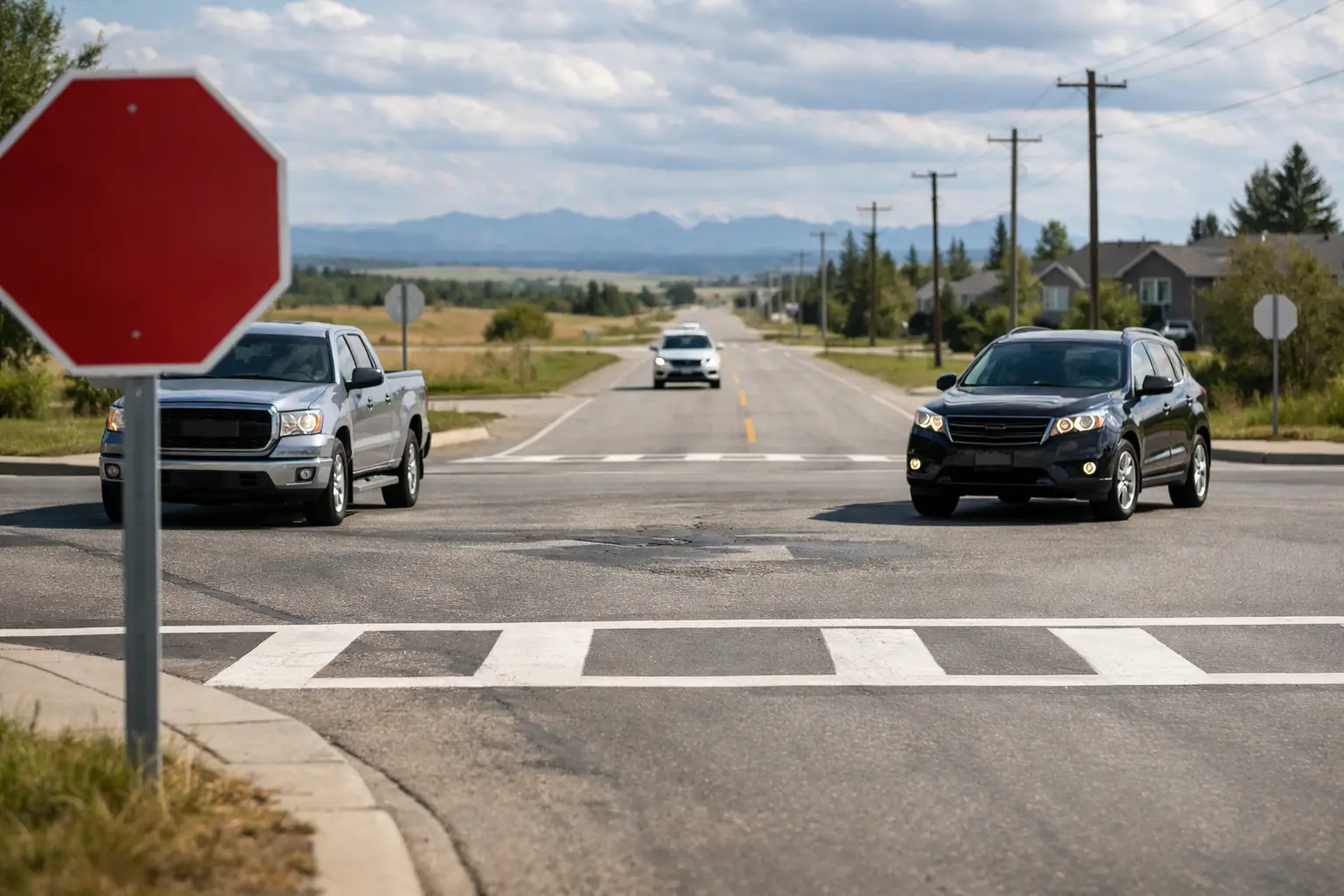
At a four-way stop, every vehicle must come to a complete stop at the marked stop line, before the crosswalk, or before entering the intersection if no line is marked. Rolling through is not a small mistake. It affects your visibility, reduces your reaction time, and can create confusion for everyone else. A complete stop is the first part of claiming your turn properly.
Right of way rules Alberta four way stop basics
The basic rule is straightforward. The first vehicle to stop is usually the first vehicle to go. If you arrive clearly before another vehicle, and you have fully stopped, you generally have the right of way to proceed when the intersection is clear.
That sounds easy, but real intersections are rarely perfect. Many drivers arrive within a second or two of each other, and not everyone stops with the same discipline. That is why defensive driving matters. Right of way is not something you take by force. It is something you use when it is safe and clear.
If two vehicles stop at the same time, the driver on the right usually goes first. This is the rule many students remember, and it is an important one. If you are on the left and another vehicle is on your right, you should yield and allow that vehicle to proceed first.
If two vehicles are directly opposite each other and both are going straight, they can usually proceed at the same time if it is safe. If one driver is turning and the other is going straight, the driver going straight generally has priority. A left turn almost always requires extra caution because it crosses the path of oncoming traffic.
Who goes first at a four-way stop in Alberta?
The safest way to decide who goes first is to use a simple order of thought. Ask yourself who stopped first, whether another vehicle is on your right, and whether anyone is turning left across traffic. That sequence solves most four-way stop situations.
If you stop first, proceed first once the intersection is clear. If you and another driver stop at the same time, yield to the vehicle on your right. If you are facing another vehicle and turning left, yield to the oncoming vehicle that is going straight or turning right.
Pedestrians also matter here. If someone is crossing legally, drivers must yield. On a road test, many errors at four-way stops happen because the student is so focused on cars that they miss a pedestrian stepping into a crosswalk.
Cyclists can add another layer. In practice, you should treat them carefully and predictably. Watch their lane position, whether they have stopped fully, and whether they are signaling. Do not assume they will move exactly like a car, but do not ignore them either.
The left-turn problem most drivers get wrong
The most misunderstood part of right of way rules Alberta four way stop intersections is the left turn. Many drivers think arriving first automatically gives them total priority. That is not always how it plays out.
If you arrive first and intend to turn left, you still need to yield to oncoming traffic that has the right to go straight through. If an opposing driver arrived at the same time and is proceeding straight, let that vehicle go first. Your left turn crosses their path, so the safer and correct decision is to wait.
If the opposing vehicle is also turning left, both drivers can usually turn left at the same time, passing in front of each other only as local lane position and safety allow. In training, we emphasize clear observation over assumptions. Just because a situation often works one way does not mean you should force it.
A good driver does not rush to prove they are right. A good driver reads the whole intersection.
When another driver waves you through
This happens all the time. Another driver hesitates, then waves you ahead. Sometimes that helps. Sometimes it makes the situation worse.
The safest response is to rely on the actual rules and only proceed if the path is clearly safe. A wave is not legal control of the intersection. It does not tell you what cross traffic, pedestrians, or cyclists are doing. If you accept the wave, do it only after checking every direction again.
For new drivers, hand gestures from other motorists often create panic. Keep it simple. Stop fully, identify who has priority, scan left-right-left, check for pedestrians, and move only when the intersection is genuinely clear. Predictable driving is safer than polite but confusing driving.
Common four-way stop mistakes on road tests
Students preparing for a Class 5 road test often lose marks at four-way stops for reasons that are completely preventable. The first is failing to make a full stop. A slow roll is still a mistake, even if no one else is there.
The second is poor observation. Some drivers stop, then stare only to the left or only at the vehicle they are worried about. Examiners want to see active scanning, including pedestrians and the full intersection environment.
The third is giving up the right of way unnecessarily. That might sound harmless, but it creates uncertainty. If it is your turn and the intersection is clear, go with control. Long hesitation can confuse other drivers and increase risk.
The fourth is taking the right of way aggressively. That usually happens when a student sees an opening and moves before confirming what another driver is doing. Confidence matters, but controlled judgment matters more.
At Turn by Turn Driving School, this is why structured in-car training matters so much. Four-way stops are not hard because the rules are hidden. They are hard because new drivers must apply the rules in real time while managing nerves, observation, and timing.
A simple approach you can use every time
When you approach a four-way stop, reduce speed early and prepare to stop smoothly. Come to a full stop in the correct position. Then scan the entire intersection and identify the other road users.
Next, decide the order. Who stopped first? If there was a tie, who is on the right? Is anyone turning left across another vehicle’s path? Are there pedestrians entering or already in the crosswalk?
Once you know it is your turn, go without drifting or second-guessing. Keep your movement steady and controlled. If it is not your turn, wait visibly and patiently. This helps other drivers understand your intentions.
This process sounds basic, but repetition builds confidence. Drivers who follow the same sequence each time are less likely to freeze, rush, or make inconsistent choices.
It depends on timing, visibility, and road conditions
There are situations where the textbook rule is only part of the answer. Snow, glare, poor sightlines, and heavy traffic all affect decision-making at four-way stops. In Alberta winters, stopping distance increases and lane markings may be harder to see. Even if it is technically your turn, you may need to wait an extra moment if another vehicle is sliding or approaching too fast.
That is where defensive driving becomes practical, not theoretical. Right of way rules tell you who should go. Defensive driving helps you recognize when the other driver may not follow the rule correctly.
This is especially important for returning drivers and internationally licensed drivers. The rule framework may feel familiar, but local habits, winter conditions, and road test expectations can differ. A calm, structured approach closes that gap quickly.
The goal is not to be the fastest driver
At a four-way stop, the safest driver is usually the one who is clear, calm, and consistent. You do not need to win the intersection. You need to show good judgment, proper observation, and control.
If you are ever unsure, stop fully, reassess, and choose the safer option rather than pushing through. Over time, the pattern becomes much easier to read. With practice, right of way decisions at four-way stops start to feel less stressful and far more automatic.
That is what good driver training should do – turn a confusing moment into a repeatable habit you can trust every time you approach the intersection.
Comments are closed