



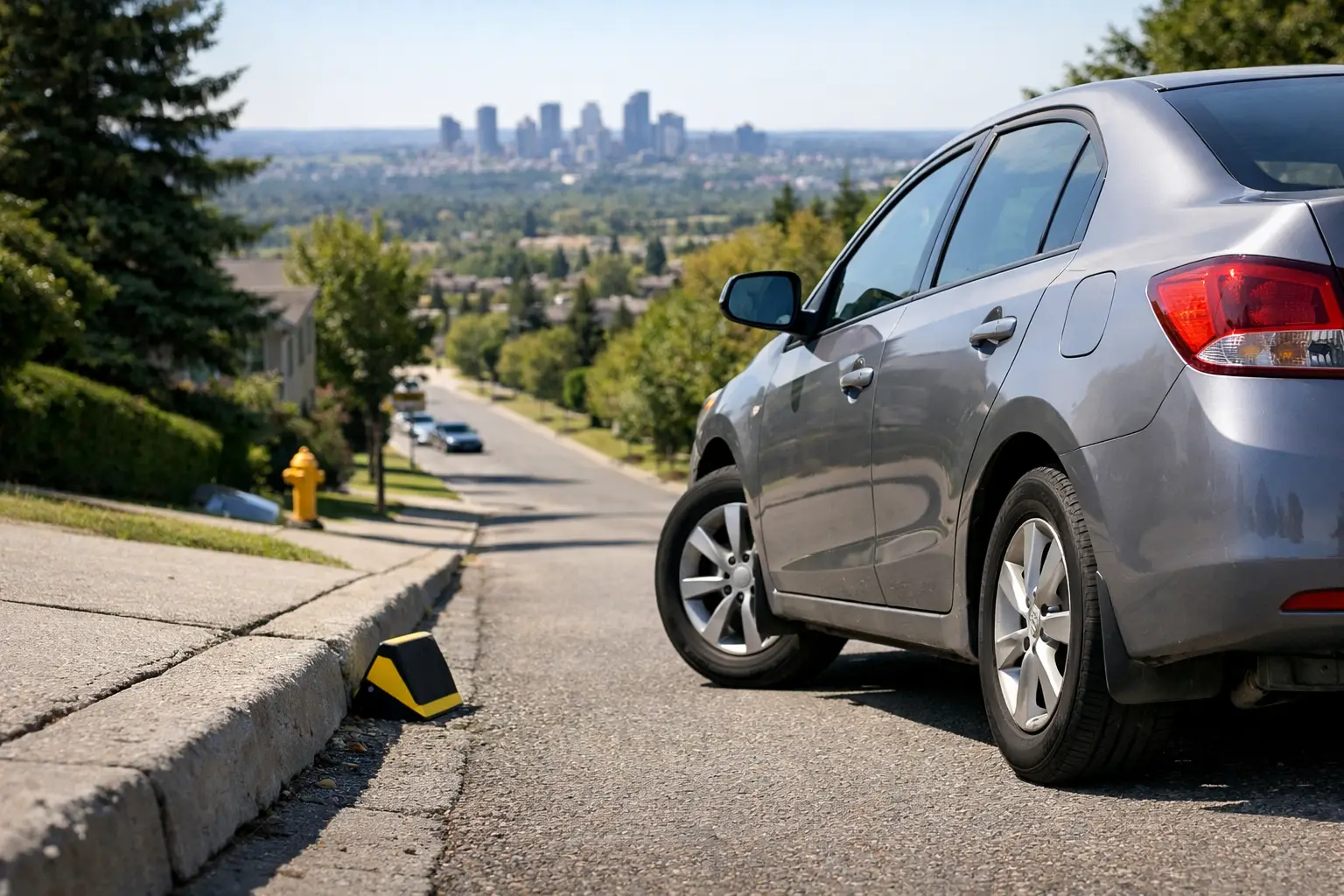
One small parking maneuver can cost you marks fast. Alberta road test hill parking rules are simple once you understand the logic behind them, but under test pressure, many drivers second-guess their wheel direction, forget the parking brake, or miss what the curb is supposed to do. This is exactly the kind of detail that separates a nervous test from a controlled one.
Hill parking is not just about memorizing left or right turns of the steering wheel. Examiners want to see that you understand how to secure the vehicle if the brakes fail and how to reduce risk to pedestrians, traffic, and property. When you treat it as a safety procedure instead of a memory trick, the steps become easier to perform correctly every time.
What examiners look for during hill parking
On an Alberta road test, hill parking is typically assessed as part of your overall vehicle control, observation habits, and parking procedure. The examiner is not only checking where you turn the front wheels. They are also looking at whether you scan properly, stop smoothly, choose the correct position near the curb, shift into the proper gear, and set the parking brake.
That matters because a correct wheel angle with poor control is still not a strong maneuver. If you roll too far from the curb, stop abruptly, forget a shoulder check, or leave the car unsecured, you are showing incomplete control. Safe driving is built on a full routine, not one isolated step.
In practice, students often lose confidence because they think hill parking is a trick question. It is not. The rule changes based on two things only – whether the car is facing uphill or downhill, and whether there is a curb.
Alberta road test hill parking rules by situation
The easiest way to remember Alberta road test hill parking rules is to think about where the vehicle would roll if it started moving on its own. Your front wheels should be turned so the vehicle is directed into a safer stopping path rather than rolling into traffic.
Downhill with a curb
Turn your front wheels toward the curb.
If the vehicle begins to roll, the front tire should contact the curb and help stop the car. This is one of the most commonly tested and most commonly missed scenarios because nervous drivers sometimes turn away from the curb by mistake.
Uphill with a curb
Turn your front wheels away from the curb.
In this position, if the vehicle rolls backward, the rear movement causes the front tire to angle toward the curb and stop the car. Many learners need to physically picture the rollback to understand why this works. Once that makes sense, the rule becomes much easier to remember.
Uphill without a curb
Turn your front wheels toward the edge of the road or shoulder.
Without a curb to catch the vehicle, you want the car to roll away from the travel lane rather than into it. This is where some students hesitate because they were taught only the curb-based version of hill parking. For the road test, make sure you know both.
What about downhill without a curb?
This situation is less commonly emphasized in basic memory shortcuts, but the safety principle remains the same: direct the vehicle so that if it moves, it does not roll into traffic. If you are practicing for your test, it is smart to review this with a qualified instructor so you are using a consistent Alberta-focused method and not mixing advice from different jurisdictions.
The full hill parking routine matters more than the wheel turn
A good hill park starts before you stop. Signal if needed, check mirrors, and scan the space so you can pull in close and parallel to the curb with control. Avoid crowding the curb too aggressively, but do not leave a large gap that suggests poor positioning.
Once stopped, keep your foot on the brake and secure the vehicle in the correct sequence. Turn the wheel to the proper direction for the hill. Then set the parking brake firmly. After that, place the vehicle in park if you are driving an automatic. If you are driving a manual, follow the correct gear procedure you have been taught for securing the vehicle.
The sequence matters because it shows intention and control. An examiner wants to see that you are not just parking casually. You are deliberately preventing movement.
Before leaving the position, make sure the vehicle stays secure. On a road test, rushing this step is a common issue. Students are so focused on the next instruction that they forget to complete the current one.
Common mistakes that cost marks
Most hill parking errors come from nerves, not lack of ability. The first mistake is turning the wheel the wrong direction because the driver relies on a phrase they half-remember instead of thinking through the vehicle’s path.
The second is forgetting the parking brake. Even if your wheel direction is correct, failing to set the parking brake can be marked as an important safety oversight. The vehicle must be secured.
The third is poor curb position. If you stop too far out from the curb, your setup is weaker and the maneuver looks unfinished. Examiners notice whether you can place the vehicle accurately.
Another common problem is incomplete observation. Parking is not separate from defensive driving. Before pulling over, before opening your door if instructed to simulate exiting, and before moving away again, proper checks are part of the task.
There is also the issue of overcorrection. Some learners crank the wheel too late, too early, or while the car is not under good control. Smooth, deliberate steering is better than a rushed movement made after the vehicle is already badly positioned.
How to remember the rule under pressure
If memory tricks help you, use them. But the more dependable approach is understanding the safety reason.
Ask yourself one question: if this car starts rolling, where do I want it to go? If there is a curb, the wheel direction should help the tire contact it. If there is no curb, the wheel direction should guide the vehicle away from the lane.
That logic holds up better under stress than repeating a phrase without understanding it. Test anxiety affects recall. Understanding reduces that problem.
It also helps to practice with the same routine every time. Pull over smoothly, stop close to the curb, hold the brake, turn the wheel correctly, set the parking brake, and secure the transmission. Repetition builds confidence, and confidence shows in the road test.
Why hill parking is really a defensive driving skill
Hill parking may look like a minor road test item, but it reflects bigger driving habits. It shows whether you anticipate risk, use the roadway correctly, and take responsibility for a vehicle even when it is stationary.
That is why structured training matters. A student who practices hill parking once or twice may remember the rule for a day. A student who learns the reason behind it, repeats it in real traffic conditions, and gets corrections from an Alberta-licensed instructor is much more likely to perform it correctly on test day and after licensing.
For new drivers, this is part of becoming dependable behind the wheel. For internationally licensed drivers or adults returning to driving, it is often about unlearning habits from another jurisdiction and replacing them with Alberta test standards. Both groups benefit from a step-by-step approach.
At Turn by Turn Driving School, that is how we teach road test preparation: clear procedures, real-world repetition, and instructor feedback that builds safe, responsible habits for life.
Practice Alberta road test hill parking rules the right way
If you are preparing for your Class 5 road test, practice hill parking in quiet residential areas first, then in more realistic driving conditions. Do not just park, check the wheels, and move on. Run the full routine each time so your body remembers the steps even when your nerves are high.
It also helps to say the situation out loud while practicing. Downhill with curb. Uphill with curb. Uphill without curb. Naming the condition before you act can improve decision speed and reduce hesitation.
If you are unsure whether your current method matches Alberta expectations, get it checked before test day. Small corrections are easier to make in practice than during an exam.
A calm, consistent driver usually performs hill parking well because the maneuver rewards process over speed. Slow it down, think about where the vehicle would roll, and secure the car with purpose. That mindset will help you through far more than one parking mark on a road test.
Comments are closed