


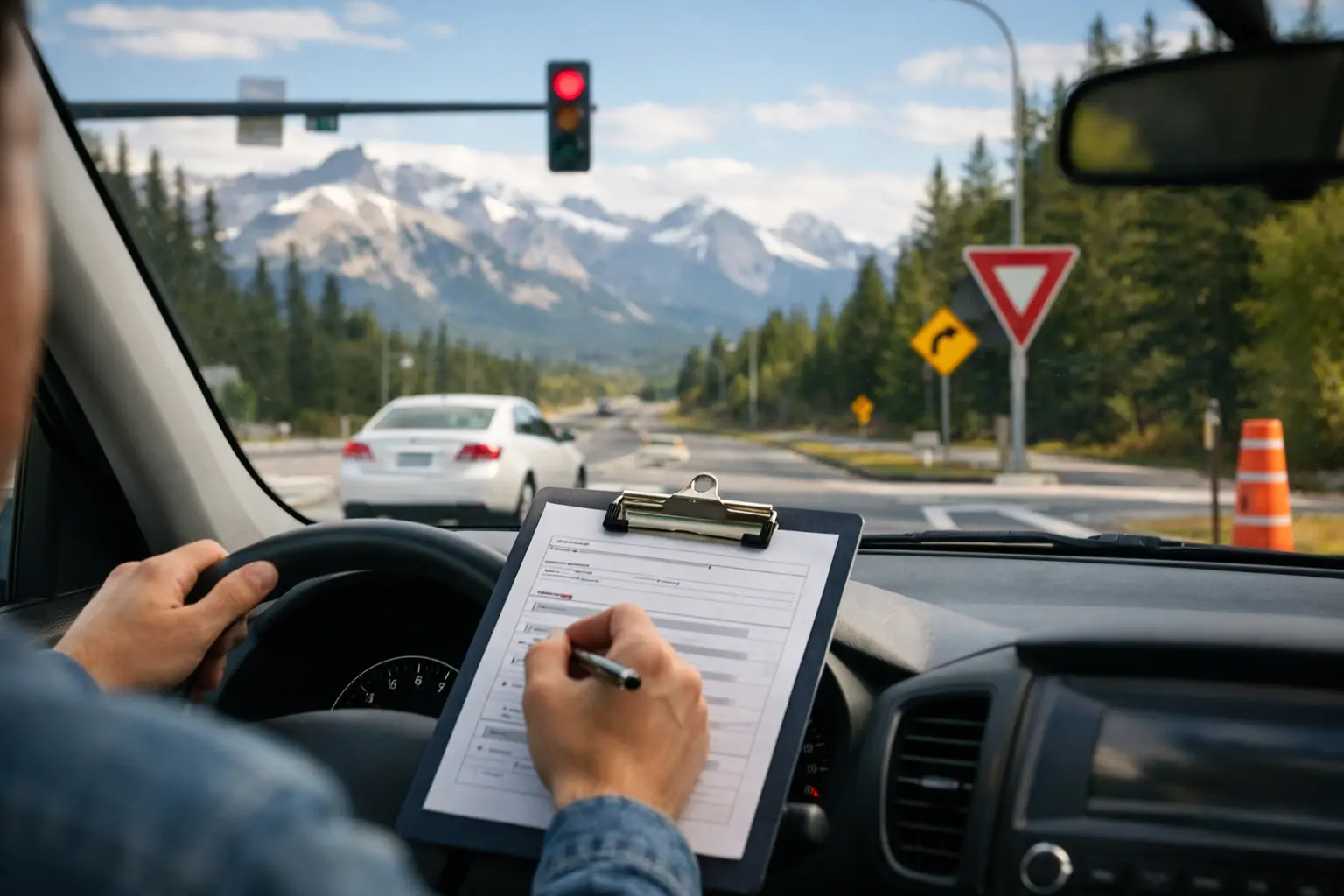
A road test can be lost in a few seconds at an intersection, not because you cannot steer or park, but because you missed a rule that experienced drivers often take for granted. The top Alberta road rules beginners miss usually involve yielding, speed-zone signs, lane position, and observation. These are also the rules that protect people walking, cycling, working roadside, and sharing busy Calgary streets with you.
Learning a rule for a knowledge test is only the first step. Applying it calmly while checking mirrors, watching traffic, and making timely decisions is what creates a safe, responsible driver for life.
1. A green light does not always mean you have the right-of-way
A solid green light allows you to proceed when the intersection is clear. It does not give you automatic priority over everyone else. When turning left on a green light without an advance green arrow, you must yield to oncoming vehicles traveling straight through the intersection. You must also yield to pedestrians legally crossing the road you are entering.
This becomes a common road-test issue when a driver pulls too far into the intersection, rushes the turn as the light changes, or turns in front of an approaching vehicle. Enter the intersection only when it is safe to do so, keep your wheels straight while waiting, and complete the turn only after the path is clear. If the light turns yellow or red while you are already legally in the intersection waiting to turn, complete your turn when traffic has stopped and it is safe.
A green arrow is different. It gives you a protected movement in the direction of the arrow. Still, scan the crosswalk and the area ahead before moving. Drivers and pedestrians do make mistakes, and defensive driving means preparing for them.
2. Right turns on red require a full stop and a full check
Unless a sign prohibits it, Alberta drivers may turn right at a red light after coming to a complete stop. “Complete” means the vehicle stops rolling behind the stop line, crosswalk, or intersection edge. Slowing down is not enough.
After stopping, check left for approaching traffic, ahead for pedestrians, and right for people using the crosswalk or a bicycle lane. Then turn only when there is a safe gap. A right turn on red is optional, not required. If traffic is moving quickly, visibility is limited, or you are uncertain about a pedestrian’s intention, wait for green.
New drivers sometimes focus so intensely on traffic coming from the left that they miss a pedestrian directly ahead. Build a consistent routine: stop, look left, look ahead, look right, then look left again before you move.
3. Crosswalks are not only painted lines
Pedestrians have the right-of-way at marked crosswalks and at unmarked crosswalks that exist at most intersections. That means a driver turning through an intersection must watch for pedestrians crossing the road, even when there are no painted lines.
Never pass a vehicle that has stopped at a crosswalk. It may be yielding to a person you cannot yet see. At a marked pedestrian crosswalk with overhead flashing lights or signs, slow early, assess the full crossing area, and stop when required. Do not begin moving again until the person has safely cleared your path.
This requires more than a quick glance. In neighborhoods, near transit stops, and around schools, scan sidewalks and driveway entrances before you reach the intersection. Hazard detection starts before the hazard steps into the road.
4. School and playground zone signs set the rule
Speed-zone rules are easy to mix up because the hours and locations can vary. In Calgary, school and playground zones are commonly signed at 30 km/h, and the posted sign tells you when the lower limit applies. Do not rely on what you remember from another neighborhood, another city, or a family member’s advice.
As you approach a zone, identify the sign early, reduce speed smoothly before entering, and maintain the lower speed until you pass the sign showing the zone has ended. Pay attention to the time restrictions printed on the sign. A school zone may apply only on school days during listed hours, while a playground zone may have different times.
The road test examiner is looking for sign recognition and speed control, not abrupt braking at the sign. Lift off the accelerator early and keep your eyes moving for children, crossing guards, parked vehicles, and doors opening into the street.
5. At an uncontrolled intersection, yield to the vehicle on your right
An uncontrolled intersection has no traffic lights, yield signs, stop signs, or traffic circle signs. When two vehicles arrive at about the same time, the driver on the left must yield to the driver on the right.
This rule matters most in quiet residential areas, where drivers can become too relaxed. Slow down enough to assess the intersection, look left, right, and left again, and be prepared to yield. If another driver reaches the intersection first, let them go first. Do not force the issue because you believe you arrived a fraction of a second earlier.
The safest decision is often the clearest one. A brief, predictable yield is better than an uncertain contest for space.
6. Roundabouts require early decisions and continuous yielding
At a roundabout, traffic already circulating has the right-of-way. Yield before entering, choose the correct lane based on your intended exit, and enter only when there is a safe gap. Once inside, continue around the circle at a controlled speed and signal right before taking your exit.
Beginners often make two opposite mistakes: stopping inside the roundabout to let another vehicle in, or entering too quickly because they are worried about holding up traffic. Neither is safe. Keep moving when your lane ahead is clear, but never enter until you can do so without causing circulating traffic to brake.
Large multi-lane roundabouts demand extra planning. Read pavement arrows and lane-use signs before you reach the yield line. If you miss your intended exit, continue around rather than cutting across lanes at the last moment.
7. Lane changes need a shoulder check, even with clear mirrors
Mirrors do not show every area beside your vehicle. Before changing lanes, make a shoulder check in the direction you plan to move. This quick look helps you identify a vehicle, motorcycle, cyclist, or other road user in your blind spot.
Use a complete sequence: check your rearview mirror, signal early, check the side mirror, shoulder check, and move only when the lane is open. Keep your speed steady and change one lane at a time. Signaling does not give you the right-of-way. You are responsible for yielding to traffic already in the lane.
The same awareness applies before pulling away from the curb, merging, or moving around a parked vehicle. Instructors look for visible observation habits because correct observation prevents collisions that a mirror-only check may miss.
8. Passing stopped roadside vehicles has special speed requirements
Alberta requires drivers to slow to 60 km/h or the posted speed limit, whichever is lower, when passing stopped emergency vehicles, tow trucks, and roadside workers with flashing lights in the adjacent lane or on the side of the road. Move over to the far lane when it is safe and when a lane is available.
Do not brake sharply at the last second. See flashing lights early, check your mirrors, signal if you can safely change lanes, and reduce speed in a controlled way. This rule is about protecting people who may be only a few feet from traffic.
9. Railway crossings demand a real assessment
A railway crossing is not a place to follow the vehicle ahead without thinking. Slow down, look both ways, and be ready to stop. Never drive around lowered gates, through flashing warning signals, or onto tracks unless you can clear the entire crossing.
Before entering, make sure there is enough space on the other side for your vehicle. Traffic congestion can leave a driver stopped on the tracks, which is never acceptable. Trains are closer and faster than they appear, and they cannot stop quickly.
Turning rules into consistent habits
The best way to avoid missing Alberta road rules is to use a repeatable driving routine. Read signs well ahead, scan intersections before reaching them, check mirrors regularly, and make decisions early enough that you do not need to rush. A road test rewards this same calm, observable process because it reflects real-world safety.
At Turn by Turn Driving School, structured in-car lessons help students practice these decisions in real Calgary traffic, with Alberta-licensed instruction focused on hazard detection, control, and road-test readiness. Practice does not mean repeating the same route. It means learning to recognize changing conditions and respond correctly every time.
Confidence comes from knowing what to do before the moment becomes stressful. Give yourself time to see, think, and act safely – that is how careful beginners become capable drivers.
Comments are closed