



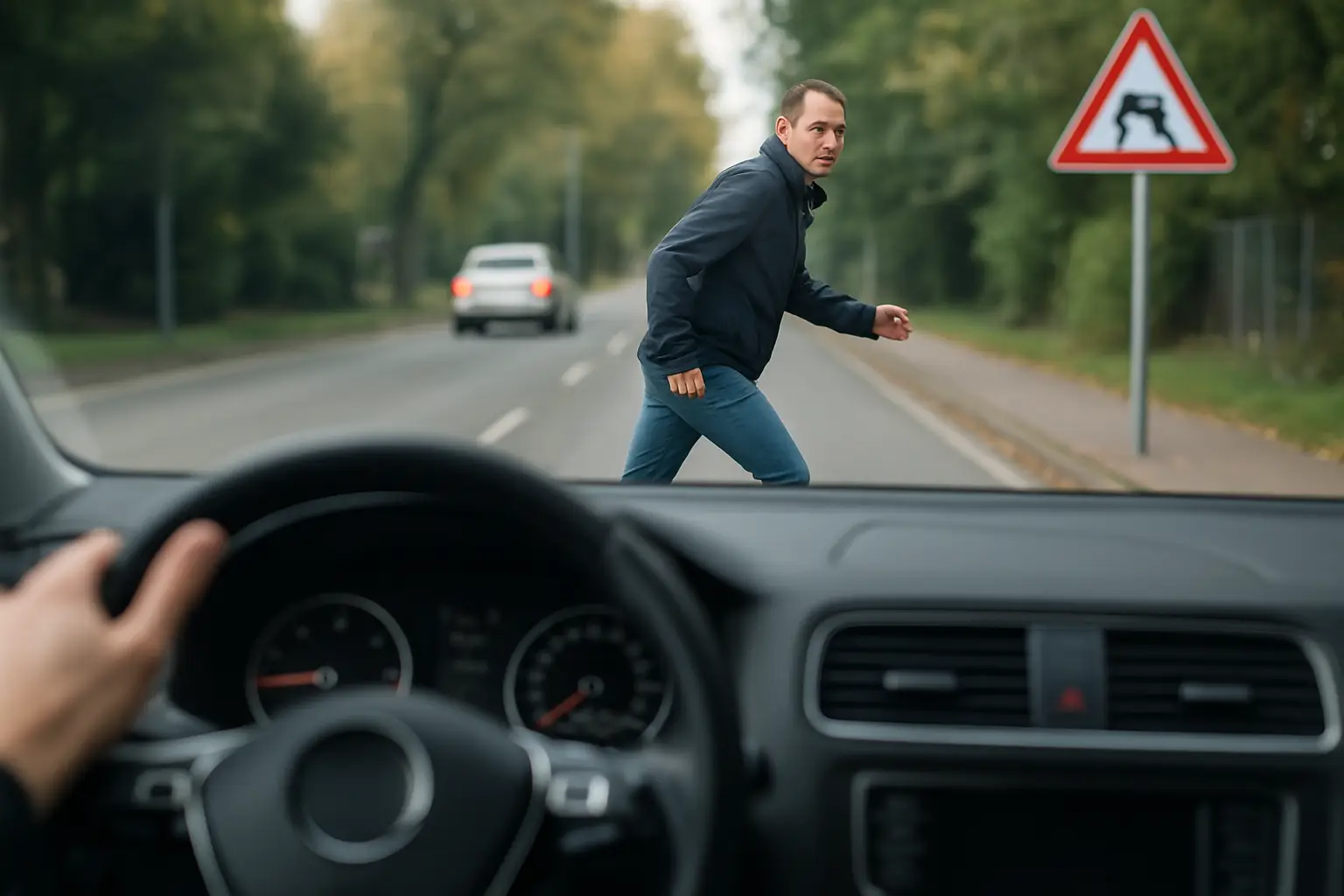
You are cruising at 35 mph and everything looks calm – until a ball rolls into the street from between two parked cars. The real question is not whether you can stop hard enough. It is whether you saw the setup early enough to slow down before the problem appeared.
That moment is hazard perception in action. It is one of the biggest differences between someone who can “operate the car” and someone who can drive safely in the real world.
What is hazard perception in driving?
Hazard perception in driving is the skill of noticing developing risks early, predicting what might happen next, and adjusting your driving in time to prevent a near miss or collision.
It is not just “seeing hazards.” Most crashes happen in plain sight. Hazard perception is about reading the whole scene: the road layout, other drivers’ behavior, visibility limits, and small clues that suggest a situation is about to change.
A hazard can be obvious, like a pedestrian stepping off the curb. But many hazards are “potential hazards” – conditions that are not dangerous yet, but could become dangerous quickly. A delivery van stopped at the curb is a perfect example. On its own, it is just a stopped vehicle. The hazard is what it hides: a person stepping out, a door opening, a vehicle pulling around it, or a child crossing in front of it.
Good hazard perception gives you time. Time to slow down smoothly instead of slamming the brakes. Time to change lanes early instead of swerving. Time to create space instead of relying on luck.
Why hazard perception matters more than quick reactions
New drivers often focus on reaction time. Experienced drivers focus on anticipation.
If you detect a hazard early, you can make small, controlled decisions – lift off the accelerator, cover the brake, increase following distance, or adjust lane position. Those small moves are safer, more comfortable for passengers, and less likely to trigger chain-reaction problems behind you.
If you detect the hazard late, the options shrink fast. You may be forced into hard braking, sharp steering, or split-second decisions where there is no perfect outcome.
This is also why hazard perception is closely tied to defensive driving. Defensive driving is the strategy. Hazard perception is the input that makes the strategy possible.
The two types of hazards you need to spot
Most driving hazards fall into two categories, and you need to treat them differently.
Immediate hazards
These require action right now. A car runs a red light into your path. A cyclist swerves to avoid debris. Traffic ahead stops suddenly. The key skill here is recognizing the hazard quickly and responding with control – braking firmly but smoothly, steering with purpose, and keeping traction.
Developing or potential hazards
These are the ones that catch newer drivers. A potential hazard is a situation that could become dangerous depending on what other people do next. Parked cars, intersections with limited visibility, a driver creeping forward at a side street, or a pedestrian near a crosswalk who looks distracted.
The best drivers treat potential hazards as “high attention zones.” They reduce risk before anything actually happens.
How hazard perception works in real traffic
Hazard perception is a loop you repeat constantly: scan, identify, predict, decide, then scan again.
Scanning means using your eyes actively. You are not staring at the car in front of you or fixating on the speedometer. You are moving your vision: far ahead for traffic flow, mid-range for spacing, near-field for lane position, and to the sides for conflict points.
Identifying is calling out what matters. Not everything matters equally. A steady car in its lane is low priority. A car drifting within its lane while approaching a merge is high priority.
Predicting is the part many drivers skip. You ask, “If this goes wrong, what is the likely next move?” For example, if you see a vehicle angled at a parking spot with reverse lights, you predict it may back out. If you see a pedestrian standing near the curb with their body angled forward, you predict they may step out.
Deciding is choosing the lowest-drama option early: ease off the gas, create space, change lanes when safe, or prepare to stop.
This loop sounds technical, but with training it becomes automatic – and that is when driving starts to feel calmer.
Common hazard perception mistakes new drivers make
Most hazard perception issues are not about intelligence or effort. They are about attention, experience, and knowing where hazards tend to appear.
One common mistake is “tunnel vision,” where you focus on the vehicle directly ahead and miss the bigger picture. Another is over-fixating on mirrors, speed, or dashboard controls, which steals time from watching what the road is doing.
A third is assuming other road users will behave correctly. Defensive drivers do not assume that. They plan for the possibility that someone will turn without signaling, roll through a stop, or change lanes late.
Finally, many newer drivers do not adjust enough for limited visibility. If you cannot see around a curve, over a hill, or past a large vehicle, you should treat it as a risk until proven otherwise. Speed limits are not guarantees of safety. They are maximums for ideal conditions.
Where hazards hide most often
If you want faster progress, train your attention around predictable “hazard zones.”
Intersections are the biggest one. Most conflicts happen where paths cross: left turns, red lights, uncontrolled intersections, and driveways. When you approach any intersection, scan wider than you think you need to – not just forward, but left-right-left, and watch for vehicles that look like they might commit late.
Parked cars create hazards because they block sightlines and produce door openings, sudden pullouts, and pedestrians stepping into the road. Your job is to slow your thinking down and give yourself space.
Merges and lane reductions are also high risk because drivers often rush, hesitate, or fight for position. The earlier you spot the merge signs and the traffic pattern, the more smoothly you can pick a gap.
Finally, watch for “confusion cues”: drivers braking for no clear reason, drifting, inconsistent speed, or stopping short. Confusion spreads. When you see it, increase space and lower your workload by choosing a safer position.
How to improve hazard perception (without guessing)
Better hazard perception comes from structured practice, not just “getting more hours.” You can build it quickly if you know what to practice.
Start by using a simple scanning routine. Look far ahead to see traffic changes early. Then check your mirrors regularly so you know your escape options. Finally, return your eyes to the areas where conflicts appear: intersections, crosswalks, driveways, and the space between parked cars.
Next, practice narrating hazards out loud when you drive with a qualified instructor or responsible supervising driver. Saying “pedestrian near the curb,” “car waiting to turn left,” or “ball near the road” forces your brain to process the risk instead of passively seeing it.
Then work on creating time and space. When you spot a potential hazard, the safest first move is usually to increase following distance or reduce speed slightly. Space buys options. Options prevent panic.
Also train “what-if” thinking in a disciplined way. You do not need to be anxious or imagine disasters. You simply identify one or two realistic possibilities and plan a calm response. If that parked car door opens, you need space. If that oncoming driver turns left across your lane, you want lower speed and an escape route.
It depends on conditions, too. At night or in rain, hazards show up later and stopping distances increase. That means your hazard perception has to start earlier – slower approach speeds, longer following distances, and more conservative decisions.
Hazard perception and road tests
Most road tests, including Alberta-style Class 5 exams, are designed to measure safe decision-making, not fancy vehicle handling. Strong hazard perception shows up in the way you approach routine situations.
Examiners notice whether you scan at intersections, manage speed for visibility, and leave enough space around hazards. They also notice when a driver “waits too long” to respond – like approaching a crosswalk quickly when pedestrians are present, or following too closely behind a vehicle that could stop suddenly.
The good news is that hazard perception is one of the most coachable driving skills. Once you learn where to look and when to adjust, your driving becomes smoother and more predictable, which is exactly what tests are built to reward.
Building hazard perception with structured lessons
Many people try to learn hazard perception by driving with friends or family. Sometimes that works, but it can also reinforce bad habits – especially if the supervising driver has been “getting away with it” for years.
Instructor-led training is different because it is deliberate. You are not just driving the same comfortable routes. You are coached to recognize patterns, manage space, and handle Calgary’s real-world conditions like busy multi-lane roads, winter visibility issues, and complex intersections.
At Turn by Turn Driving School (https://turnbyturn.ca), hazard detection is treated as a core safety skill, not an afterthought. That shows up in how lessons are structured: clear objectives, repeated practice in real traffic, and feedback that connects what you saw to what you did next.
Driving gets less stressful when you stop being surprised. Hazard perception is how you get there – by seeing the clues early, making calm choices, and building the kind of confidence that holds up on the road test and long after you pass.
If you want one mindset shift to carry into your next drive, make it this: do not aim to handle hazards well. Aim to spot them early enough that you barely have to handle them at all.
Comments are closed