



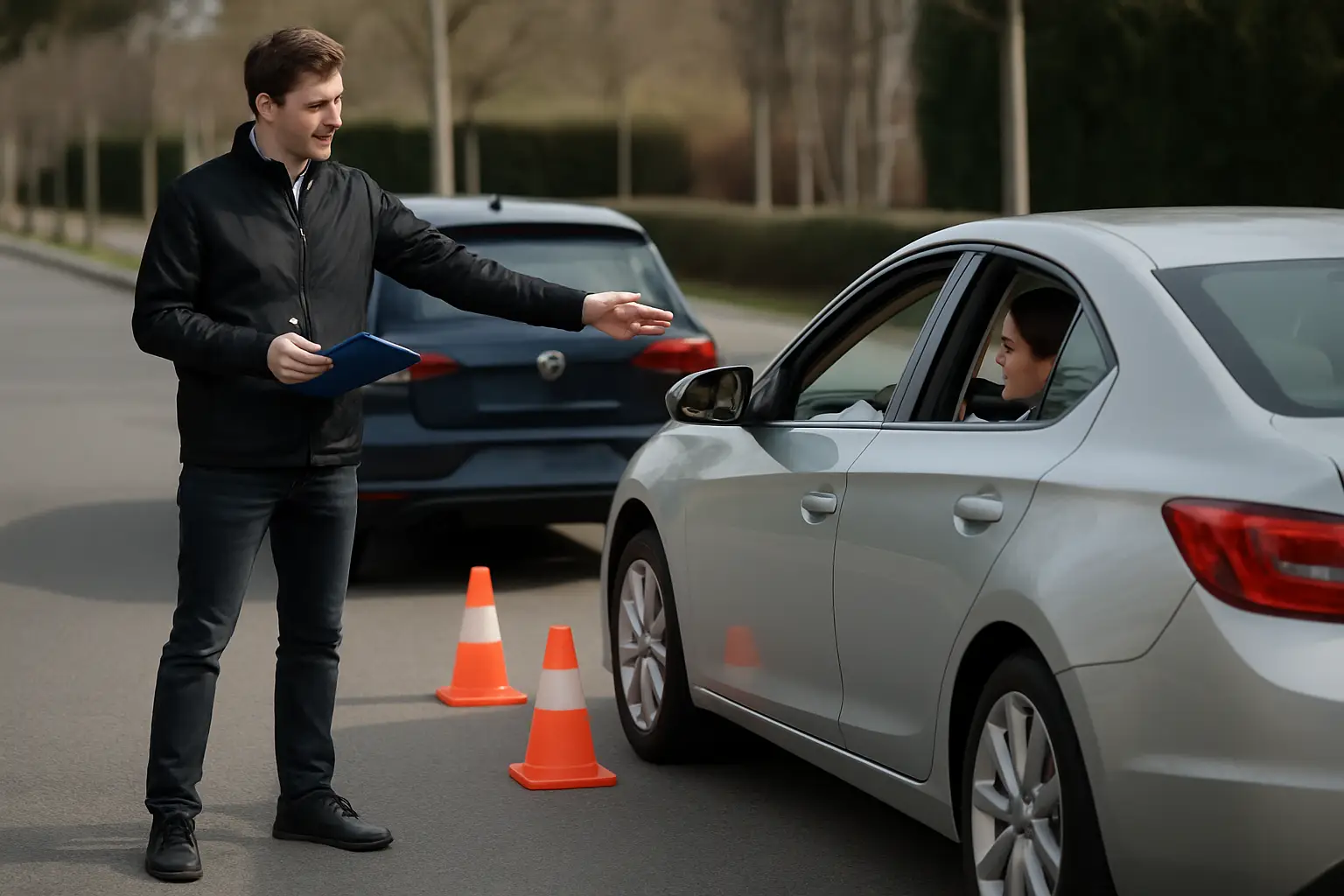
You can be a calm, safe driver all day – and still feel your stomach drop when the examiner says, “Pull over here and parallel park behind that vehicle.” The good news is parallel parking is one of the most teachable skills on the Alberta road test because it rewards consistency more than “feel.” If you use the same setup, the same reference points, and the same observation routine, you can make it predictable.
What examiners in Alberta are really looking for
On the road test, parallel parking is not a trick maneuver. It is a quick audit of three things: control of the vehicle at low speed, awareness of your surroundings, and decision-making that protects other road users. A clean park with weak observation can still cost you, and a slightly imperfect position with strong control and safety checks can sometimes be acceptable. It depends on how safe your actions are and whether the final position would reasonably be considered legal and non-obstructive.
Examiners typically watch for your mirror checks, shoulder checks, signaling, speed control, steering control, and whether you can finish parked close enough to the curb without touching it. They also watch whether you adjust properly when the first attempt is not working. You are allowed to correct, but you need to do it safely and deliberately.
Parallel parking tips for Alberta road test success: the setup matters
Most parallel parking problems start before the car even goes into reverse. Your setup creates the space and angles you need, and it keeps you from rushing.
Choose a spot that is realistic. If the examiner points to a location behind a parked vehicle, do not assume you must squeeze into a tiny gap. If there is an obvious, safe place behind a single parked car with adequate room, that is usually the intent.
As you approach, scan early. Check your rearview mirror and side mirrors for traffic behind you, cyclists, and pedestrians near the curb. Signal right well before you stop. Your signal tells the driver behind you that you are about to slow down and possibly reverse.
Stop parallel to the vehicle you will park behind. A reliable baseline is to align your rear bumper with the other vehicle’s rear bumper, leaving about 2-3 feet of side-to-side space. Too close and you will struggle to swing the front without clipping. Too far and you will land wide from the curb.
Before you shift to reverse, pause. This is where strong drivers separate themselves from fast drivers. Check mirrors. Shoulder check over your right shoulder to confirm the blind spot is clear. If anything is moving into the space, you wait. On a road test, waiting is often the safest and highest-scoring choice.
The step-by-step movement that stays consistent
Parallel parking is easiest when you break it into phases and move slowly. A slow roll gives you time to check and time to stop.
Phase 1: back to the “entry angle”
With the wheel straight, begin reversing slowly. Keep your foot hovering over the brake so you can stop instantly. Continue until your right rear corner is near the other vehicle’s rear corner, or until your chosen reference point lines up (for many drivers, this is when the back of the parked car reaches a specific point in your rear side window).
Then steer sharply right. The goal is to angle your car into the space without letting the front swing too wide into traffic.
Observation does not stop because the wheel is turning. Alternate your view: right mirror and right shoulder check for curb and pedestrians, then a quick scan left to make sure your front end is not drifting into a moving lane.
Phase 2: “tuck the rear in”
Continue reversing at a crawl until your car reaches roughly a 45-degree angle to the curb. You should now be moving into the space with your rear wheel approaching the curb area.
At this point, many drivers either keep turning too long or they straighten too early. Either mistake forces big corrections later. If you feel unsure, stop. Stopping is allowed. Rolling blindly is not.
Phase 3: bring the front in and straighten
When your rear is in and your front is still out, steer sharply left while continuing to reverse slowly. This swings your front into the space behind the parked car.
Keep watching the front-left corner of your car. This is the part that can clip the vehicle in front if you misjudge. Use your left mirror and quick left shoulder checks as needed.
As the car becomes parallel with the curb, straighten the wheel to finish backing into position. Stop before you touch the curb.
Phase 4: center the vehicle
Once you are parallel, you may need to pull forward slightly to center your car between the vehicle ahead and behind. This is where controlled corrections matter.
Signal if you need to move out, check mirrors, and shoulder check the direction you are moving. Keep your movements small. Examiners want to see you can fix the park without panic or guesswork.
Observation routine: what to do with your eyes and head
In Alberta road tests, observation is not optional. Examiners can forgive a slow maneuver. They cannot ignore missing shoulder checks when you reverse into an active environment.
Build a repeatable scan pattern. Before reversing: rearview mirror, both side mirrors, right shoulder check. While reversing: primarily look where the car is going (over your right shoulder) while using mirrors for precision, then add quick scans left to ensure your front end remains clear.
If pedestrians are nearby, be extra conservative. Stop early and let them pass. You do not want to be the driver inching backward while someone is stepping off the curb.
If there is traffic approaching from behind, wait. A common test mistake is starting the reverse while a vehicle is close behind. Even if they slow down, you are still creating unnecessary risk.
Speed and steering control: slow is not “hesitant”
Drivers sometimes worry that going slowly looks uncertain. On a road test, slow and controlled reads as safe and deliberate, as long as you keep the car moving when it is clear to proceed.
Use “creep speed” with light brake control. Jerky acceleration or riding the gas while turning sharply can cause you to swing wide or hit the curb.
Steer decisively. Parallel parking is one of the few times you actually want strong steering input. Half-turning the wheel and hoping the car drifts in usually creates extra corrections and more risk.
Common road test faults – and how to prevent them
Most parallel parking deductions come from predictable patterns. Fix the pattern, not the symptom.
Hitting the curb is a big one. It usually happens because the driver turns right too early, reverses too quickly, or is not using the right mirror to track curb distance. Slow down and use the mirror actively.
Parking too far from the curb is also common. That is often a setup issue (starting too far from the parked car) or a timing issue (straightening the wheel too early). If you end up wide, correct safely by pulling forward and adjusting rather than accepting a poor final position.
Missing shoulder checks is another major problem, especially when shifting into reverse or moving forward to correct. Make it automatic: every gear change that changes your direction comes with a mirror check and a shoulder check.
Turning the wheels while stopped is not typically a “fail,” but it can signal poor control, and on some surfaces it is hard on tires. More importantly, it often means the driver is not coordinating steering with slow movement. A tiny roll while turning helps the car respond more smoothly.
Blocking traffic unnecessarily can hurt you if you create a hazard. This is where judgment matters. If the street is narrow and a line forms behind you, stay calm, keep your signal on, and finish efficiently – but do not rush the safety checks.
It depends: real-world variables that change the maneuver
Parallel parking is not always the same because streets are not always the same.
On a downhill or uphill grade, your car may roll faster than expected. Use firmer brake control and be ready to stop sooner. After you park, secure the vehicle properly. If you are on a hill, the examiner may watch for safe parking habits like setting the parking brake and turning the wheels appropriately.
In winter conditions, snowbanks can hide the curb line and reduce your usable space. Treat packed snow like a curb you should not climb. If visibility is reduced, go even slower and use your mirrors to track the edge of the road.
If the parked vehicle is a large SUV or truck, your reference points might shift because you cannot see as much. In that case, rely more on your own car’s position relative to the curb and your mirror view rather than the other vehicle’s bumper.
How to practice so it holds up under test pressure
If you only practice parallel parking “until you get one good one,” it will fall apart under pressure. You want repetition with a consistent method.
Practice in the same kind of environment you will be tested in – residential streets with real curbs, occasional traffic, and normal distractions. Use safe, legal locations and avoid busy roads until your control is solid.
Aim for consistency over perfection. Your goal is to finish within a reasonable distance of the curb, parallel, without contact, using correct observations. If you can do that five times in a row, you are ready.
If you want coached repetition with clear reference points tailored to your vehicle, Turn by Turn Driving School in Calgary builds parallel parking into road test prep so you are not guessing which cues work for your seating position and mirror setup.
Day-of test reminders that actually help
Arrive early enough that you are not starting stressed. Adjust your seat, mirrors, and steering wheel before you pull out. A poor seating position changes your sight lines and makes parallel parking harder than it needs to be.
When the examiner asks you to parallel park, buy yourself a moment by setting up properly. Signal, check mirrors, stop parallel, and do your observation routine. You are not being graded on speed. You are being graded on safe execution.
If your first attempt is off, do a safe correction. Check, signal if needed, and adjust calmly. A controlled correction is better than forcing a bad park.
A helpful way to think about parallel parking on the Alberta road test is this: you are demonstrating that you can place your vehicle precisely while staying responsible for everything happening around it. Treat it as a safety exercise, not a stunt, and the maneuver gets much easier to manage under pressure.
Comments are closed