



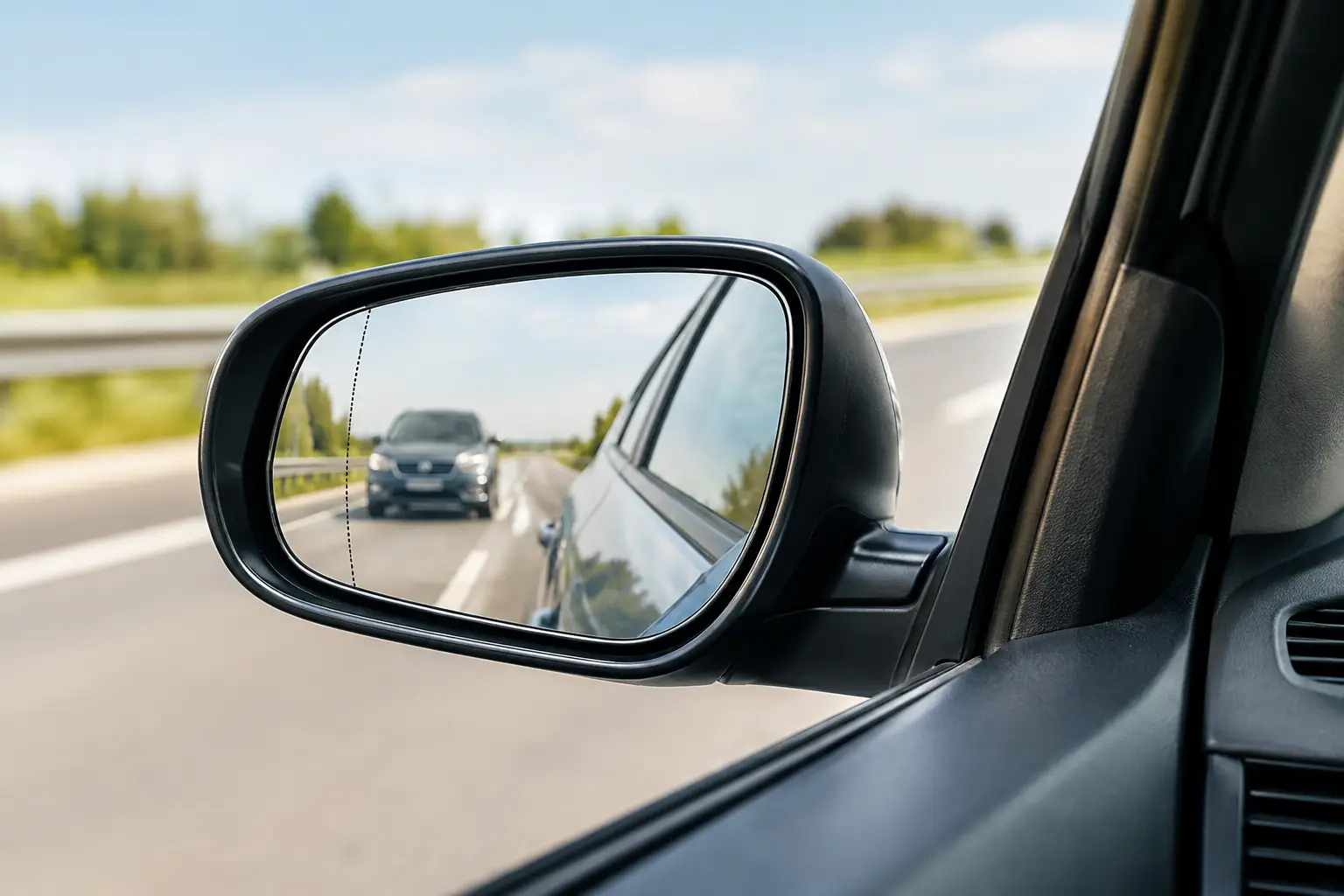
A mirror can show you a great deal, but it cannot show everything. Learning how to check blind spots is one of the driving habits that separates a driver who simply reacts from one who actively manages risk. Before you move your vehicle sideways, turn across traffic, merge, or back up, take a deliberate look where your mirrors cannot see.
For new drivers, the goal is not to make a fast head movement just because an examiner expects it. The goal is to gather the information you need to move safely. With practice, the correct mirror checks, shoulder checks, signals, and speed adjustments become one controlled routine.
What Is a Blind Spot?
A blind spot is an area around your vehicle that is not visible in your rearview mirror or side mirrors. The size and location of these areas depend on the vehicle, mirror adjustment, seating position, and nearby traffic. A motorcycle, cyclist, pedestrian, or small vehicle can be hidden there long enough to create a serious conflict.
Your mirrors reduce blind spots. They do not eliminate them. This is why a shoulder check is necessary before any sideways movement. Looking over your shoulder gives you a direct view of the lane or space beside your vehicle that mirrors may miss.
Blind spots are not limited to highway lane changes. They matter when leaving the curb, merging onto a freeway, turning at an intersection, entering a roundabout, pulling out of a parking space, and backing up. Defensive driving means recognizing that another road user may be close even when the path first appears clear.
How to Check Blind Spots in the Correct Order
A good blind-spot check is brief, purposeful, and timed correctly. You should keep the vehicle moving straight and maintain awareness of what is ahead while you check. Turning your head for too long can cause you to drift or miss sudden braking in front of you.
Use this sequence when changing lanes, merging, or moving away from the curb:
- Check your rearview mirror to understand the traffic behind you.
- Check the side mirror on the side you intend to move toward.
- Signal early enough to communicate your intention.
- Check the blind spot by briefly looking over the shoulder in the direction of the move.
- Move only when the space is open, then continue checking ahead as you change position.
The signal does not give you the right of way. It gives other road users information. If a vehicle is already beside you, if a cyclist is approaching, or if another driver speeds into the gap, wait. Missing a turn or exit is safer than forcing a lane change.
The Shoulder Check: Quick, Direct, and Controlled
For a left lane change, look over your left shoulder. For a right lane change, look over your right shoulder. Your eyes should return forward immediately after the check. Do not lean far forward, twist your entire body, or stare beside the vehicle. A quick glance is enough when it is combined with properly adjusted mirrors and an early signal.
Many new drivers make one of two mistakes: they look too quickly to actually process what is there, or they look for so long that they stop monitoring the road ahead. Practice the movement while parked first. Sit upright, keep both hands ready on the steering wheel, and turn your head just enough to view the adjacent lane.
Set Your Mirrors Before You Drive
Mirror adjustment is your first line of defense. Set the inside rearview mirror so it frames the full rear window. You should see directly behind your vehicle without moving your head.
Set each side mirror while seated in your normal driving position. Aim it outward enough to show the lane beside your vehicle, with only a small amount of your own vehicle visible at the inside edge. If your side mirrors show too much of the vehicle’s body, you are giving up useful coverage of nearby lanes.
Even with ideal mirror positioning, use a shoulder check. Mirror setup makes your checks more efficient, but it cannot account for every angle, every vehicle size, or every road user moving through traffic.
Blind-Spot Checks for Common Driving Situations
Changing Lanes and Merging
On faster roads, traffic can close a gap quickly. Begin scanning well before you need to move. Check mirrors, signal, check the blind spot, and adjust your speed to fit naturally into an available space. Avoid slowing suddenly in a travel lane while waiting for a gap unless traffic conditions require it.
When merging, focus on matching the speed of traffic when possible. A blind-spot check is especially important because drivers in the lane you are entering may be difficult to see in a side mirror. If there is no safe opening, do not push another driver to brake or swerve for you.
Turning at Intersections
Before making a right turn, check your right-side mirror and blind spot for cyclists, pedestrians, scooters, and motorcycles. Someone traveling along the curbside may be hidden beside your vehicle, particularly if you have slowed for the turn.
Before a left turn, continue scanning for oncoming traffic and pedestrians in the crosswalk. Your left shoulder check may also be needed if you are moving into a turning lane or shifting position to complete the turn. The exact check depends on the road layout, but the principle stays the same: look toward the space you plan to enter.
Pulling Away From the Curb
A parked vehicle is not automatically safe to move. Before leaving the curb, check the rearview mirror, signal, check the side mirror, and shoulder check toward the traffic lane. Watch for approaching vehicles, bicycles, and people walking near the vehicle.
If you have been parked on a busy street, wait for a clear, predictable gap. Pulling out slowly does not make the movement safe if another road user is already beside you.
Backing Up and Parking
Blind spots are especially serious in parking lots and driveways. Rearview cameras and parking sensors are helpful tools, but they do not replace a visual check. Cameras may not detect a child, pet, low object, or cross-traffic approaching from the side.
Before reversing, check around the vehicle. Look over your right shoulder through the rear window while backing slowly, and scan mirrors for movement around the sides. If your view is blocked by a large vehicle, parking stall, or obstacle, pause and reassess. When needed, get out and look before continuing.
Avoid These Common Blind-Spot Mistakes
Do not rely on a quick mirror glance alone. A vehicle can be beside you in the time between mirror checks. Do not change lanes immediately after signaling, either. Give other drivers a moment to see your signal, then complete your mirror and shoulder check.
Avoid drifting toward the next lane while you are deciding whether it is clear. Keep your vehicle centered until you have confirmed the space and committed to a controlled movement. Also, do not assume another driver has checked their blind spot. Stay out of other vehicles’ blind zones whenever practical, especially beside large trucks and buses.
Distractions make this routine less reliable. Adjust navigation, music, and climate controls before moving. If you are tired, rushed, or anxious about missing an exit, give yourself more time and choose the safer option of continuing ahead.
Build the Habit Before Your Road Test
A road test evaluates more than whether you can make a lane change. It shows whether you observe, communicate, and make decisions with safety and control. Examiners look for purposeful observation, but the habit matters far more after the test is over.
During structured in-car lessons, practice saying the sequence quietly to yourself: mirror, signal, shoulder check, move when clear. As the routine becomes familiar, you will no longer need to recite every step. You will recognize developing hazards earlier and make smoother decisions.
At Turn by Turn Driving School, instructors help students apply these checks in real Calgary traffic, from quiet residential streets to multi-lane roads and highway merges. The objective is not to rush through a maneuver. It is to build the judgment needed to become a safe, responsible driver for life.
Every successful blind-spot check comes down to one choice: slow down mentally before moving physically. Give yourself time to see, decide, and act only when the space is truly clear.
Comments are closed