



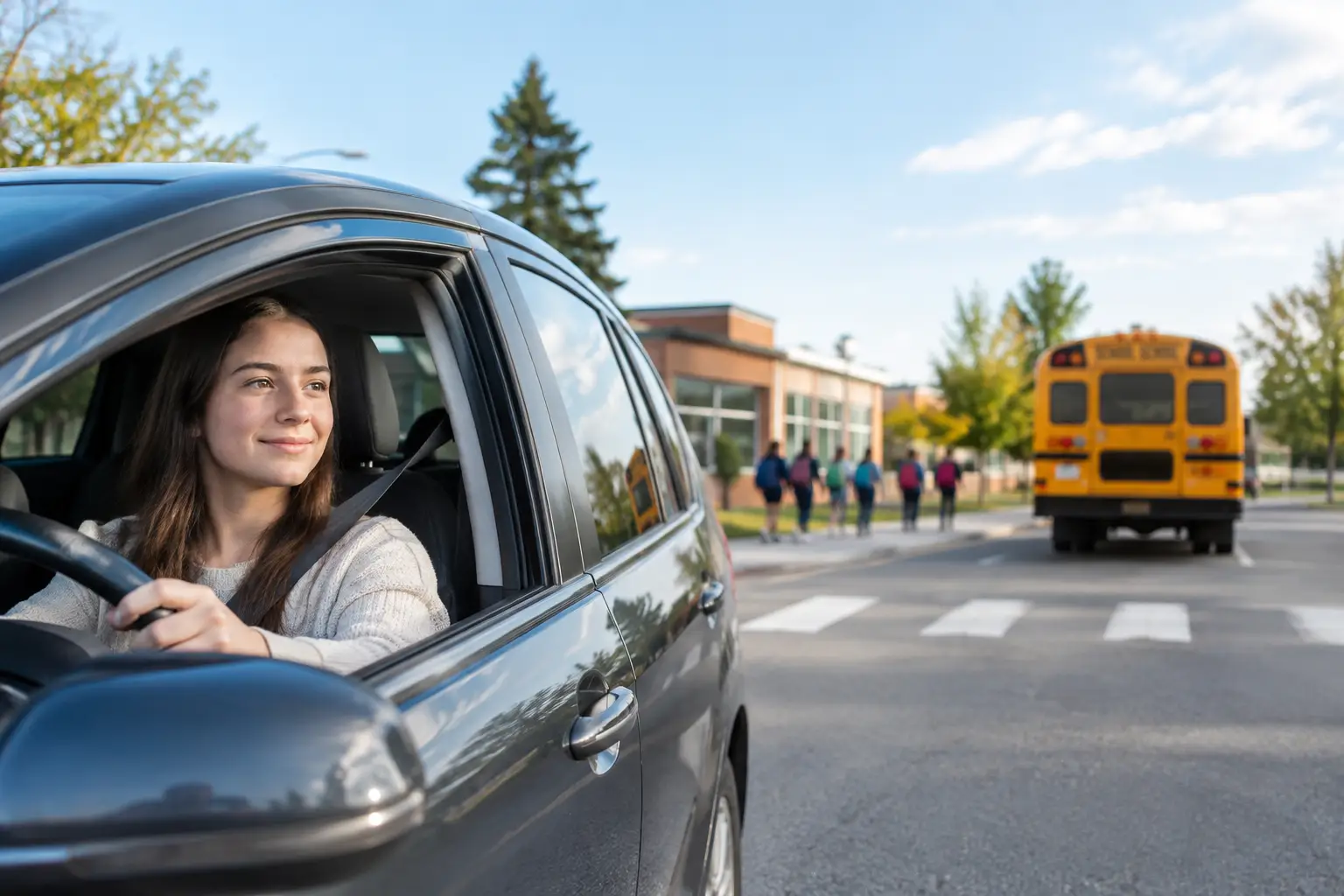
A school-zone sign should change your driving plan before you reach it. You are not simply reducing your speed. You are entering an area where a child may step off a curb, a parent may make an unexpected stop, or a school bus may block your view. This Alberta school zone driving guide gives new, returning, and internationally licensed drivers a practical way to handle these areas with safety and control.
For Calgary learners, school zones are a regular part of real-world driving and the Class 5 road test environment. The goal is not to creep through nervously or focus only on avoiding a ticket. The goal is to read the roadway early, manage your speed smoothly, and leave enough space to respond when children behave like children – quickly and unpredictably.
Alberta School Zone Driving Guide: Know When the Rule Applies
In Alberta, a school zone speed limit is generally 30 km/h unless a sign posts a different limit. For drivers more familiar with U.S. measurements, 30 km/h is about 19 mph. The reduced limit generally applies on school days from 7:30 a.m. to 4:30 p.m., but posted signs are always the instruction to follow. Some communities may use signs with different hours or conditions.
Do not assume the zone is inactive because you do not see students outside. A school may have early drop-off programs, recess, staggered dismissal, sports practices, or staff and families crossing the road. If the sign says the school-zone hours are in effect, drive at the posted speed until you pass the end-of-zone sign.
A common learner mistake is braking hard at the sign. That can surprise the driver behind you and show poor speed management. Instead, scan for the sign well ahead, check your mirrors, ease off the accelerator, and brake progressively as needed. Your vehicle should be at the reduced speed by the time you enter the zone.
School zones and playground zones are not the same
In Calgary, school zones and playground zones can have different signs, hours, and rules. A playground zone often operates for longer daily hours than a school zone, including weekends. The sign tells you what applies. Treating every reduced-speed area as if it has identical hours can lead to unsafe assumptions.
Build one dependable habit: read the sign, including the smaller panel beneath it. Look for the posted speed, the zone type, the hours, and the end-of-zone marker. When visibility is poor because of snow, glare, or a large vehicle, slow down early and give yourself more time to confirm what the sign says.
Control Your Speed Before You Need to Brake
The posted limit is a maximum, not a target you must reach. At 30 km/h, you have more time to see a child near the curb and more ability to stop safely. But conditions may call for an even lower speed. A narrow street packed with parked vehicles, a snowy crosswalk, or a busy dismissal line all reduce what you can see and how much grip your tires have.
Choose a speed that allows you to remain in control without holding up traffic unnecessarily. On a clear, dry road with good sightlines, the posted limit may be appropriate. In heavy rain, during the first snowfall, or when children are gathered near parked cars, slow down further. Drivers behind you may be impatient, but they do not decide the safe speed for your vehicle.
Keep a larger following distance as you approach a school. Vehicles may stop suddenly to drop off a child, wait for a crossing guard, or yield to a pedestrian. A minimum following distance that feels comfortable on an open road may not be enough in a crowded school area. Give yourself space so you can brake smoothly instead of reacting late.
Scan for Hazards, Not Just Signs
School-zone driving is a hazard-detection exercise. Your eyes should move between the roadway ahead, sidewalks, crosswalks, parked vehicles, intersections, and mirrors. Staring only at the vehicle in front of you leaves you unprepared for someone entering your path.
Pay close attention to visual clues. A backpack near the curb, a ball rolling into the road, an open vehicle door, or a group of children facing away from traffic can all signal that movement may follow. A child may cross from between parked vehicles, particularly during drop-off and pickup periods.
Parked SUVs, buses, and snowbanks can hide pedestrians until the last second. When your view is blocked, do not continue at the same speed and hope the lane stays clear. Reduce speed, cover the brake, and be ready to stop. This is defensive driving in practice: expecting a possible risk before it becomes an emergency.
Crosswalks require your full attention
At a marked crosswalk, watch for pedestrians who are already crossing and those preparing to enter the roadway. Yield as required and remain stopped until you can proceed safely. Do not pass a vehicle that has stopped at a crosswalk. It may be yielding to a pedestrian you cannot see.
Avoid waving pedestrians through if it creates confusion with other lanes of traffic. Your job is to follow the rules, maintain a predictable position, and communicate clearly with your vehicle movements. A pedestrian should not have to guess whether you have seen them.
Handle School Buses Correctly
A stopped school bus with flashing red lights and an extended stop arm requires immediate attention. On an undivided road, traffic in both directions must stop. Stop at least 20 meters behind the bus when approaching from the rear, or 20 meters in front when approaching from the opposite direction. Remain stopped until the red lights stop flashing and the bus begins moving, or until the driver signals you to proceed.
The exception is a road divided by a median or other physical barrier. Traffic approaching from the opposite direction does not have to stop in that situation, but drivers traveling behind the bus still must stop. A painted line alone does not create the same separation as a physical median.
Do not try to judge whether children have finished crossing based on a quick glance. The bus lights and stop arm control the situation. Passing a stopped school bus is dangerous, can carry serious penalties, and is a clear sign of poor judgment on a road test.
What Examiners and Instructors Look For
During a Class 5 road test, a school zone gives an examiner a clear view of your observation, speed control, and decision-making. They are watching whether you identify signs early, reach the correct speed before entering the zone, check mirrors before slowing, and scan actively for pedestrians.
They also notice whether your driving is predictable. Sudden braking, inconsistent speed, drifting toward parked cars, or focusing on the speedometer for too long can create risk. Check your speed briefly, then bring your attention back to the road. With practice, 30 km/h becomes a feel you can maintain through steady accelerator control.
For nervous drivers, it helps to practice school zones outside the busiest pickup period first. Learn the route, locate the signs, and get comfortable recognizing the end of each zone. Then practice when pedestrian activity is higher with an Alberta-licensed instructor who can coach your scanning and timing in real traffic.
Build a Routine You Can Use Every Time
Use the same sequence each time you approach a school area: spot the sign early, check mirrors, reduce speed smoothly, scan sidewalks and crosswalks, create space ahead, and look for the end-of-zone sign before increasing speed. A repeatable routine reduces anxiety because you are not making up a response in the moment.
Avoid distractions completely. Put your phone away before driving, set navigation before moving, and keep conversations low-key near schools. Even a two-second glance away from the road at 30 km/h covers meaningful distance, especially when a child is close to the curb.
At Turn by Turn Driving School, in-car lessons focus on the habits behind safe decisions: observation, hazard recognition, speed management, and calm control. Those skills matter long after the road test because school zones are places where responsible driving protects people who have the least ability to protect themselves.
The next time you see the fluorescent school-zone sign, give yourself permission to slow down early and drive deliberately. A few extra seconds is a small cost for the time, space, and control that keep a child safe.
Comments are closed