



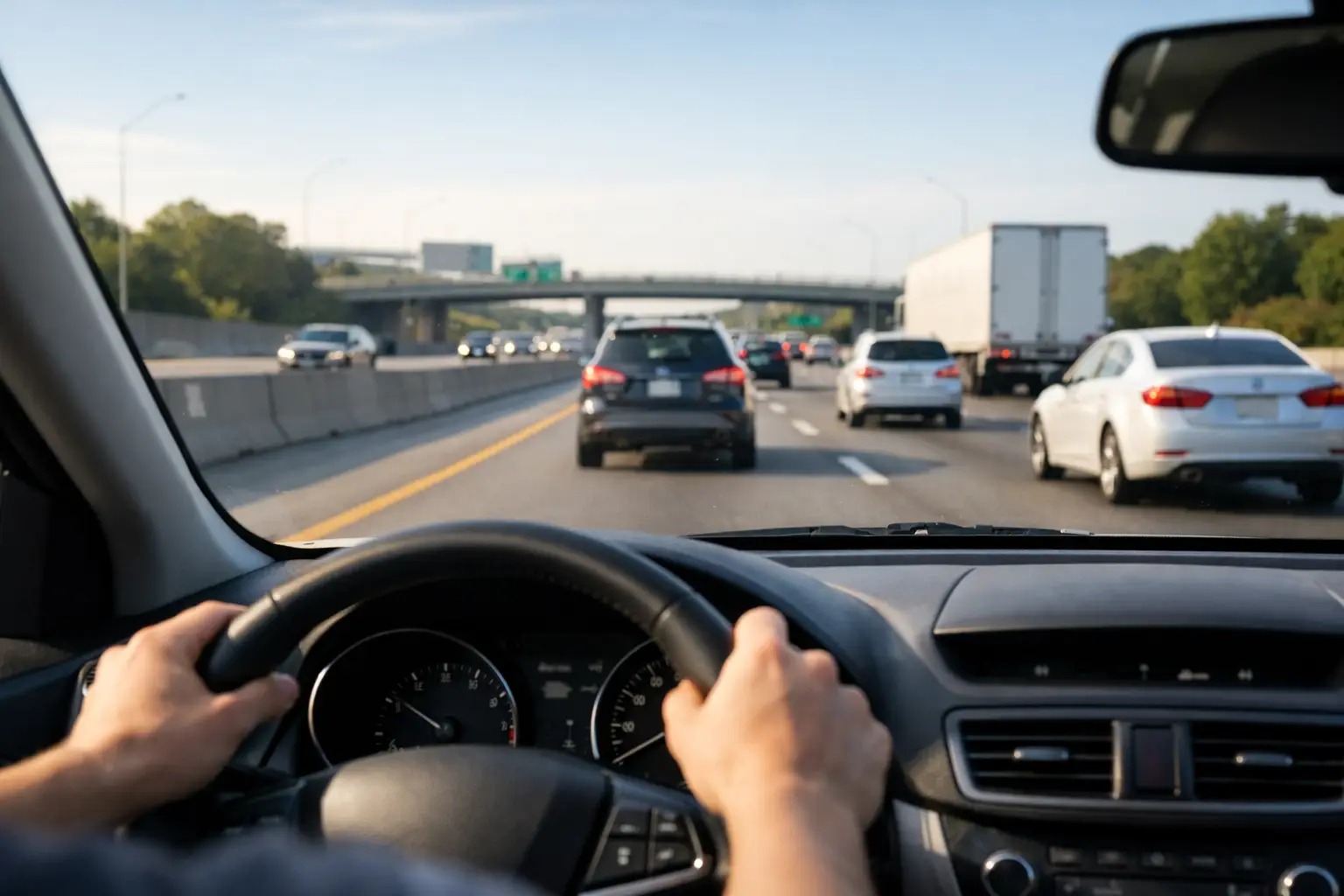
A highway entrance ramp can feel much faster than a quiet neighborhood street. Traffic is moving, space is limited, and every decision has to be deliberate. This highway driving skills guide helps new and returning drivers build the habits needed to enter, travel on, and exit high-speed roads with safety and control.
Highway confidence does not come from forcing yourself into heavy traffic before you are ready. It comes from practicing the right sequence: observation, speed control, space management, and calm decision-making. These skills are especially valuable for Class 5 GDL drivers preparing for more independent driving in Calgary and surrounding areas.
Build highway skills before the on-ramp
A successful highway drive starts before you enter the highway. Adjust your seat so you can fully press the pedals while maintaining a slight bend in your knees. Set your mirrors to reduce blind spots, fasten your seat belt, and put your phone away before the vehicle moves.
You should also know your route. Identify the entrance, the exit you need, and any major lane changes ahead of time. Navigation instructions are useful, but they should never replace looking through the windshield and reading road signs. If you miss an exit, continue safely and take the next available route. A missed turn is never a reason for a sudden lane change or hard braking.
For new drivers, the best progression is gradual. Begin on less busy divided roads with an experienced instructor or supervising driver, then practice at different times of day and in different traffic volumes. A clear, dry afternoon is a sensible starting point. Night driving, rain, snow, strong winds, and rush-hour traffic add risks that require more experience.
Enter the highway by matching traffic speed
The acceleration lane is designed to give you room to reach a safe speed before merging. Use it. Drivers often make one of two mistakes: entering too slowly and disrupting traffic flow, or accelerating without first identifying a safe gap.
As you travel down the ramp, look well ahead and check traffic in the lane you will join. Use your signal early, check your mirrors, and perform a shoulder check toward the lane you are entering. Your mirrors show part of the picture, but a shoulder check confirms whether a vehicle is beside you in the blind spot.
Your goal is to match the general speed of traffic while choosing a gap. You may need to adjust by gently accelerating or easing off the gas. Do not stop at the end of an acceleration lane unless traffic conditions leave no safe alternative. Stopping makes it harder to build enough speed to merge and can create a serious rear-end risk.
Drivers already on the highway should also help when conditions allow. If it is safe, create space by adjusting speed or moving to another lane. However, the driver entering the highway still has the responsibility to merge only when there is a safe opening.
Keep your eyes moving
Do not stare at the vehicle directly ahead. Scan far down the roadway, then check your mirrors regularly. This gives you more time to identify slowing traffic, debris, brake lights, construction zones, and vehicles preparing to change lanes.
A useful habit is to maintain a visual lead time. At highway speeds, hazards develop quickly. Looking far ahead lets you respond with a smooth speed adjustment instead of an abrupt brake application.
Maintain space, speed, and lane position
Once you have merged, settle into a safe following distance. In favorable conditions, use at least a three-second gap behind the vehicle ahead. Pick a fixed object such as a sign or light pole. When the vehicle ahead passes it, count the seconds until you reach the same point.
Increase that space when roads are wet, icy, dark, crowded, or affected by reduced visibility. You also need more distance behind large trucks, motorcycles, and vehicles carrying unstable loads. The correct gap depends on conditions, but more space consistently gives you more time to see, think, and act.
Maintain a legal speed that suits the road conditions and traffic flow. Driving at the posted limit may still be too fast in snow, rain, fog, or heavy congestion. At the same time, driving far below the normal speed of traffic without a reason can create a hazard. Choose a speed you can control while remaining predictable to other drivers.
Stay centered in your lane and avoid drifting. Keep both hands ready on the steering wheel, particularly near large vehicles, bridge decks, open areas with crosswinds, and uneven pavement. Small, smooth steering inputs are more effective than constant corrections.
Change lanes with a complete check
Lane changes are routine, but they demand a full observation process every time. Signal early enough to communicate your plan. Check your rearview mirror, check the side mirror in the direction of travel, then complete a shoulder check. Only move when the lane is clearly open and there is enough space both ahead and behind.
Do not rely on a turn signal to create a gap. A signal communicates intention; it does not give you the right-of-way. If another driver is in your blind spot or closing the gap, remain in your lane and wait.
When passing, make one lane change at a time. Pass at a safe, legal speed, leave enough room before returning to your lane, and avoid cutting closely in front of the vehicle you passed. On multi-lane highways, stay aware of faster-moving traffic and avoid unnecessary time in a passing lane.
Large trucks require extra patience. They have larger blind spots, need more room to stop, and may create wind turbulence as you pass. Never drive beside a truck longer than necessary, and do not merge back in front of one until you can see its headlights in your rearview mirror.
Handle highway hazards without panic
Defensive driving is not about expecting every other driver to make a mistake. It is about leaving yourself room to respond if they do. Watch for vehicles that wander within their lane, brake repeatedly, travel unusually fast or slow, or approach an exit late. These behaviors may signal an unexpected lane change.
If traffic suddenly slows, ease off the accelerator first and brake smoothly as needed. Check your mirrors before braking firmly so you understand what is behind you. Avoid swerving unless there is a clear, safe path. At highway speeds, a controlled reduction in speed is usually safer than a sudden maneuver.
In poor weather, reduce speed early, increase following distance, and make all inputs gentle. Hard braking, sharp turns, and rapid acceleration can lead to loss of traction. If visibility is poor, turn on the appropriate lights and focus on being visible as well as seeing other road users.
If your vehicle has a mechanical problem, signal, move toward a safe shoulder or exit when possible, and slow gradually. Do not stop in a live lane unless there is no other option. Once stopped in a safe location, assess the situation and seek assistance rather than attempting a risky repair beside moving traffic.
Exit with the same level of attention
Many drivers relax too early when they see their exit. Plan ahead by moving toward the correct lane well before the exit ramp, but do not make an early or rushed lane change. Signal, check mirrors and blind spots, and enter the deceleration lane.
Reduce speed on the ramp, not while still traveling in the highway lane. Exit ramps can be sharper than they appear, especially at night or in wet and icy conditions. Look through the curve, keep a steady steering input, and avoid braking hard while turning.
Practice until the routine feels calm
Highway driving is a skill set, not a test of nerve. A structured lesson gives you an opportunity to practice merging, lane changes, passing, exits, and hazard detection with direct coaching instead of guessing whether you handled a situation correctly.
At Turn by Turn Driving School, instructors help students connect defensive-driving theory to real-road decisions through planned in-car lessons. The goal is not simply to complete a highway trip. It is to develop the observation, judgment, and control that support safe, responsible driving for life.
Before your next highway practice drive, choose one skill to improve, whether that is maintaining a longer following distance or completing more confident shoulder checks. Repetition with a clear purpose turns highway driving from stressful to manageable.
Comments are closed