


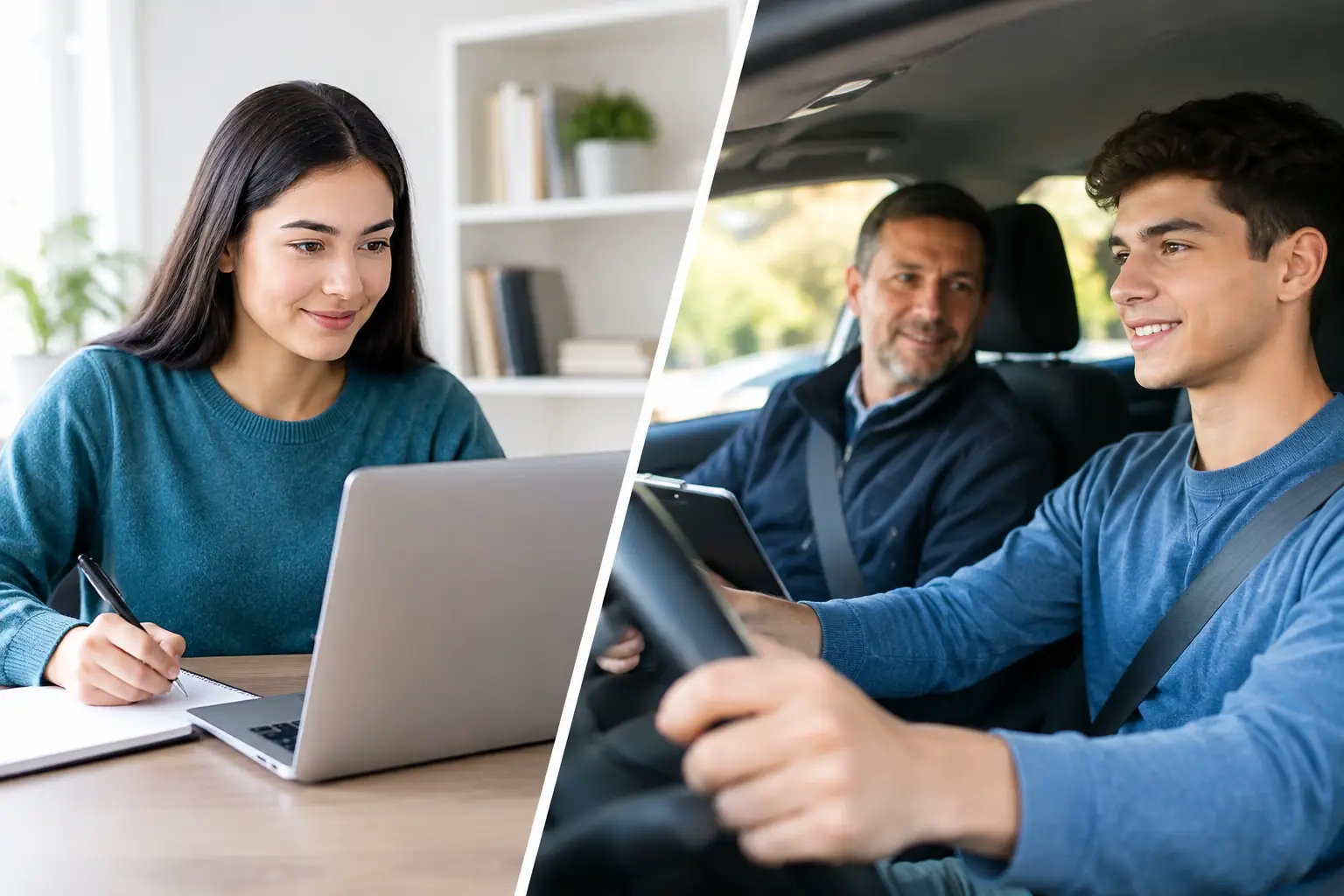
A driver can memorize a right-of-way rule at midnight from a phone. That same driver may still hesitate when traffic closes in at a busy Calgary intersection, a pedestrian steps toward a crosswalk, or the road turns slick after a sudden temperature drop. That is the real question behind self paced driver education vs live instruction: not which format is better in isolation, but which parts of driving each format can teach well.
For new Class 7 drivers, returning drivers, and people adjusting to Alberta road rules, the strongest training plan usually combines both. Self-paced education gives you flexibility and a reliable foundation. Live instruction turns that knowledge into safe decisions, vehicle control, and calm habits on real roads.
What Self-Paced Driver Education Does Well
A self-paced online classroom course lets students work through the theory of driving on a schedule that fits school, work, family responsibilities, or shift changes. Instead of being tied to one evening class, you can review a lesson when you are focused and return to a topic when you need a refresher.
This format is especially useful for learning the information that requires repetition. Rules of the road, signs, lane markings, sharing the road with cyclists, impaired-driving consequences, and basic defensive-driving concepts all benefit from careful review. Students can pause, reread, and complete modules at a steady pace rather than trying to absorb everything in a single classroom session.
Online learning can also help anxious beginners arrive better prepared for their first in-car lesson. When you already understand mirror checks, following distance, shoulder checks, and intersection scanning, the instructor can spend more time helping you apply those skills behind the wheel.
At Turn by Turn Driving School, the 15-hour online classroom module is designed to provide that foundation. It gives students a structured way to learn theory before and alongside their in-car training, without adding unnecessary scheduling pressure.
Flexibility is valuable, but it requires follow-through
Self-paced learning works best for students who set a routine. It is easy to postpone an online module after a long day or rush through material simply to finish it. Neither approach supports safe driving.
A better approach is to complete shorter sections consistently, take notes on unfamiliar rules, and revisit topics that feel unclear. Treat the course as preparation for real driving decisions, not just a requirement to check off before a road test.
Where Live Driving Instruction Matters Most
No online lesson can fully recreate the feeling of controlling a vehicle in traffic. Live instruction gives students immediate coaching while they manage speed, steering, braking, observation, and decision-making at the same time.
An Alberta-licensed instructor can see habits that students often miss on their own. Maybe you brake too late before a stop sign, enter turns too quickly, focus too closely on the vehicle ahead, or forget a shoulder check before moving laterally. These are not small details. They affect whether you can recognize hazards early and respond with control.
In-car instruction also teaches timing. Knowing that you should scan an intersection is different from learning when to scan, where to look, and how to keep moving safely while you do it. Knowing the rule for a lane change is different from judging a safe gap, checking mirrors, signaling early, performing a shoulder check, and changing lanes smoothly without disrupting traffic.
That feedback is most effective when it happens in the moment. An instructor can explain what went wrong, help you correct it on the next attempt, and adjust the lesson to your current level of confidence. This is particularly valuable for students who have practiced with family or friends but need more consistent coaching before a road test.
Real conditions build real judgment
Road tests measure more than whether you can recite rules. Examiners watch how you manage the vehicle, observe your surroundings, follow signs and signals, choose safe gaps, and respond to changing conditions.
Live lessons give students experience with situations that are hard to understand from a screen: merging into faster traffic, approaching uncontrolled intersections, parking on a busy street, turning left across oncoming vehicles, navigating construction zones, and maintaining space around large trucks. Calgary weather adds another layer. Rain, snow, glare, ice, and reduced visibility all require drivers to adjust speed, following distance, and braking habits.
A qualified instructor will not simply direct every move. The goal is to help students develop independent judgment so they can drive safely when no one is sitting beside them.
Self Paced Driver Education vs Live Instruction: The Key Trade-Offs
The choice is not really between convenience and quality. Each format has a different job.
Self-paced education is efficient for building knowledge. It gives students control over when they study and allows repeated review of rules and safety concepts. It is often a practical option for busy learners who need predictable progress around other commitments.
Live instruction is essential for developing physical skill and situational awareness. It gives you professional feedback, exposure to real traffic conditions, and a clear view of the habits that could affect your safety or road-test performance.
Self-paced learning alone may be enough to improve your understanding of traffic laws, especially if you are an experienced driver seeking a refresher. It is not enough, by itself, to prove that you can safely handle a vehicle under pressure. On the other hand, live lessons without a solid theory foundation can slow progress because valuable driving time gets spent reviewing basic rules that could have been learned beforehand.
For most new drivers, the best answer is a structured combination: learn the concepts online, then practice and refine them during instructor-led lessons.
Who Benefits Most From a Blended Program?
Teen drivers working from a Class 7 learner’s license toward Class 5 GDL benefit from a clear sequence. Online learning gives them a consistent safety framework, while multi-day, two-hour in-car lessons help them build skills without becoming overwhelmed. Two-hour sessions provide enough time to practice several related tasks while still allowing students to stay focused.
Young adults balancing school or work often value the convenience of completing classroom material on their own time. They still need in-car lessons that fit their schedule and prepare them for the local roads and maneuvers they will face during a road test.
Internationally licensed drivers and returning drivers may already be comfortable operating a vehicle, but comfort does not always equal readiness for Alberta driving expectations. A brush-up lesson can identify differences in lane discipline, intersection procedures, signage, parking practices, and defensive-driving standards. In these cases, self-paced review supports local knowledge while live instruction verifies that the driver can apply it safely.
Drivers with test anxiety also benefit from the blended approach. Anxiety often decreases when the process is predictable. Studying the rules builds understanding; instructor feedback builds evidence that you can perform the skills. By the time a road test approaches, the goal is not to feel perfect. It is to feel prepared, observant, and in control.
How to Get More From Both Formats
Start your online modules before your first lesson if possible. Pay close attention to right-of-way rules, signs, speed management, following distance, and visual scanning. Write down questions instead of guessing.
During in-car instruction, ask your instructor to explain the reason behind corrections. A direction such as “scan earlier” becomes more useful when you understand that early scanning gives you more time to spot hazards and make smooth decisions rather than abrupt ones.
Between lessons, practice only within your licensing restrictions and only when conditions are appropriate. Focus on one or two instructor-assigned skills at a time. Repeating a mistake without feedback can strengthen the wrong habit, while targeted practice helps good habits become automatic.
Finally, do not measure progress only by whether you can complete a parking maneuver or pass a practice route. Measure it by whether you can stay calm, observe consistently, manage space, and make safe choices when the situation changes.
A license is an important milestone, but safe driving is the outcome that lasts. Use flexible online learning to understand the rules, then use professional in-car instruction to turn that knowledge into the judgment and control needed for every trip after the test.
Comments are closed