


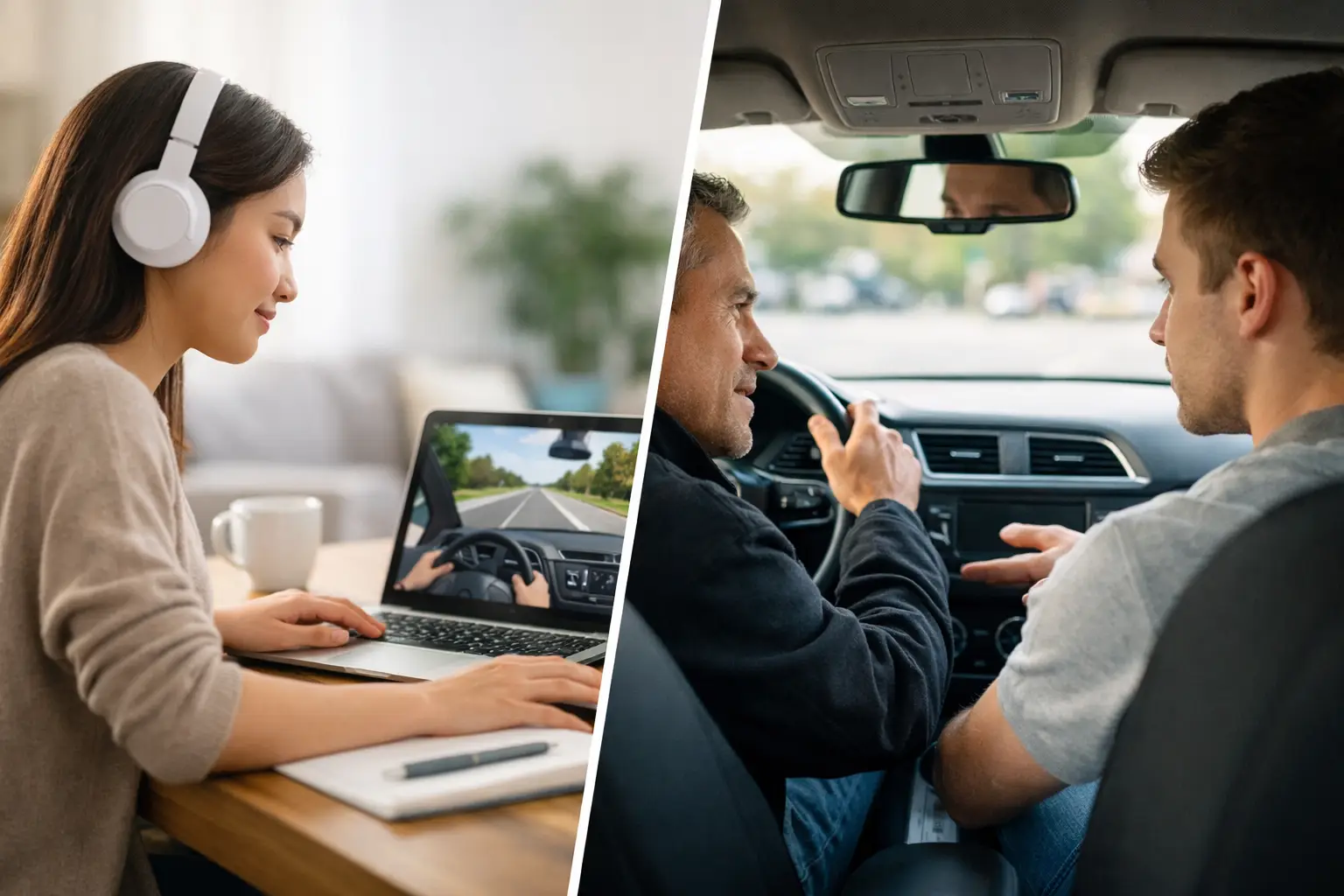
If you are trying to choose between online driver education vs in car lessons, the real question is not which one is better in every case. It is which part of driving you need to learn right now, and what kind of structure will help you become safe and consistent behind the wheel.
New drivers often assume one format should cover everything. It does not. Driving is both knowledge and execution. You need to understand rules, signs, right-of-way, and hazard awareness. You also need to brake smoothly, judge gaps, manage speed, scan intersections, and stay calm in traffic. Those are different skills, and they are not learned the same way.
For most students, online learning and in-car instruction work best together. One gives you the foundation. The other shows whether you can actually apply it under real road conditions.
Online driver education vs in-car lessons: what each teaches
Online driver education is designed to teach the theory side of driving in a clear, structured way. That includes traffic laws, road signs, lane positioning, space management, defensive driving habits, and the consequences of poor decisions. A strong online course also helps students understand why the rules exist, not just how to memorize them for a test.
This format is especially useful for students who need flexibility. Self-paced modules let you review material after school, after work, or on weekends. If a topic takes longer to understand, you can revisit it without feeling rushed. That matters for anxious first-time drivers and for adults returning to driving after years away.
In-car lessons do something completely different. They turn knowledge into behavior. It is one thing to know that you should check mirrors, scan ahead, and shoulder check before changing lanes. It is another thing to do all three in the correct sequence while maintaining speed and position in active traffic.
That is why in-car training matters so much. An Alberta-licensed instructor can observe your timing, correct unsafe habits early, and coach you through situations that online coursework cannot recreate with enough pressure or complexity. Students often discover that what felt easy on a screen becomes much harder at a busy intersection.
Where online driver education works best
Online learning is a strong fit for students who need convenience, structure, and repetition. If your schedule changes week to week, self-paced classroom training is easier to complete consistently than fixed in-person theory sessions. It also gives families a predictable way to fit driver education into a busy routine.
It is also effective for building the mental side of safe driving. Hazard detection starts before the car moves. Good drivers learn to expect problems, not just react to them. Online modules can slow situations down, explain what to watch for, and reinforce defensive habits in a way many new drivers need before they ever enter traffic.
For students preparing for licensing milestones, online driver education can reduce confusion. It lays out the process, the rules, and the expectations step by step. That clarity helps students move forward with more confidence and fewer gaps in their understanding.
Still, online learning has limits. It cannot measure how gently you steer, whether you hesitate too long at a left turn, or how well you recover when another driver behaves unpredictably. It can explain the correct response. It cannot confirm you can perform it safely.
Where in-car lessons make the biggest difference
In-car instruction is where habits are formed. This is the stage where students learn spacing, speed control, intersection judgment, parking technique, lane changes, and real-time decision-making. These are not small details. They are the difference between a driver who knows the rules and a driver who can use them under pressure.
Professional lessons also create accountability. A friend or family member may offer useful practice, but informal instruction is often inconsistent. Important steps get skipped. Unsafe shortcuts go uncorrected. Feedback can be vague, emotional, or based on habits that will not hold up well on a road test.
A structured lesson is different. The instructor has a plan, watches for patterns, and builds skills in a sequence. Students usually progress faster because they are not just driving around. They are working on specific objectives, often in 2-hour blocks that allow enough time to practice, receive corrections, and try again.
That structure is especially helpful for nervous drivers. Confidence does not come from being told to relax. It comes from repeating the correct actions until they start to feel controlled and familiar.
Online driver education vs in-car lessons for road test prep
If your immediate goal is passing a road test, you still should not treat online driver education vs in car lessons as an either-or decision. Road tests evaluate both knowledge and execution, even though the examiner mainly sees the driving itself.
Students who skip theory often make avoidable errors because they do not fully understand what the examiner expects. They may roll through stops, miss school zone details, choose poor lane positions, or misunderstand right-of-way. These are knowledge problems showing up as driving errors.
Students who skip professional in-car training have the opposite issue. They may know the right answer when asked, but they struggle with timing, observation routines, speed consistency, or parking under test conditions. These are execution problems, and they are common.
The strongest preparation usually starts with a classroom foundation, then moves into on-road coaching with targeted feedback. Higher-value training programs are built around that sequence for a reason. Students learn the rules first, then practice applying them in multi-day lessons that develop consistency before test day.
Which option is better for different types of drivers?
For a first-time teen driver, the best choice is usually a program that combines both formats. Teens need clear rules, repeated exposure to defensive concepts, and professional coaching before bad habits settle in. Online coursework gives them flexibility. In-car lessons give them supervision and accountability.
For young adults with packed schedules, online learning is often the easiest place to start. It lets them make progress immediately instead of waiting for the perfect week to begin. But if they want real confidence in traffic, they should follow it with structured on-road training rather than relying only on occasional practice.
For internationally licensed drivers, it depends on experience and local familiarity. Some drivers already have strong vehicle control but need help adjusting to Alberta road rules, signs, winter conditions, and test expectations. In that case, a refresher approach with focused in-car sessions may be enough. Others benefit from reviewing theory first so they understand the local framework before driving.
For adults returning to driving after a long gap, the emotional side matters as much as the technical side. Online education can rebuild understanding at a comfortable pace. In-car lessons then help restore confidence with an instructor who can adjust the pace and focus on the situations that feel most challenging.
The real trade-off is convenience vs live correction
If there is one honest trade-off in online driver education vs in car lessons, it is this: online training wins on convenience, while in-car lessons win on real-time correction.
Online learning is available when you are. You can stop, restart, review, and learn at your own pace. That makes it efficient and accessible.
In-car lessons are less flexible because they require scheduling, instructor availability, and focused practice time. But they give you something online courses cannot – immediate correction in the moment a mistake happens. That is often where the deepest learning occurs.
The best driver education programs do not force students to pick one and hope for the best. They combine self-paced theory with practical lessons so each stage supports the next. That model respects how driving is actually learned.
A structured package can also remove a lot of uncertainty. When students know how many classroom hours they need, how in-car lessons are divided, and what outcomes to expect, they are more likely to stay consistent. That is one reason many learners choose schools such as Turn by Turn Driving School, where online modules and in-car instruction are organized into clear programs rather than left as separate pieces.
Good driver education should do more than help you check a licensing box. It should help you recognize risk sooner, respond with control, and build habits you can rely on long after the road test is over. If you are deciding where to start, choose the format that fits your next step – but do not ignore the value of the other one. Safe, responsible drivers are built through both understanding and practice.
Comments are closed