



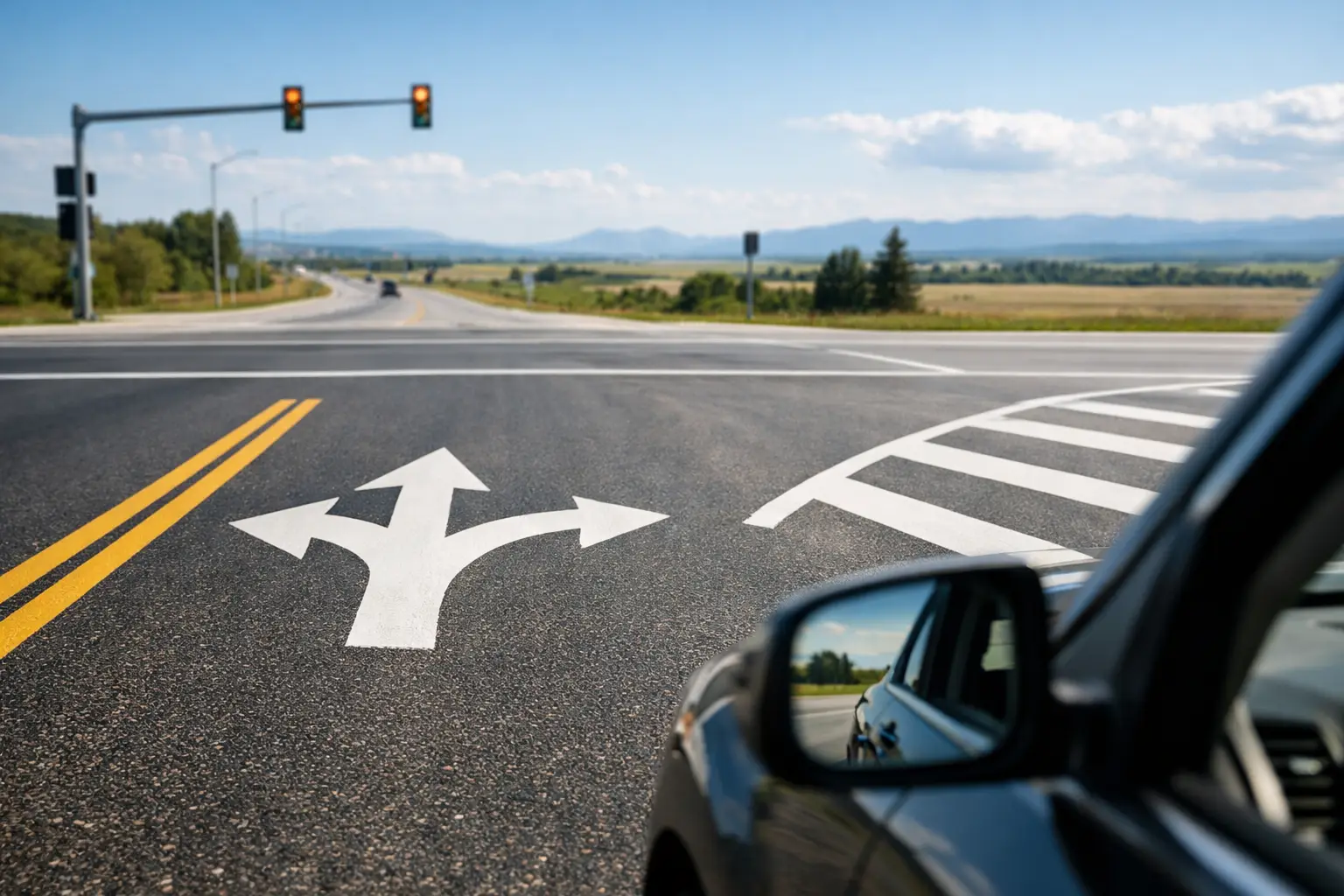
A painted line can change what you are allowed to do in a matter of seconds. Understanding pavement marking meanings helps you make safe decisions before you reach an intersection, approach a crosswalk, or consider changing lanes. For new Alberta drivers, these markings are not details to memorize for a knowledge test and forget. They are active instructions that support predictable, defensive driving.
Road conditions, traffic flow, signs, signals, and the directions of a peace officer always matter. Pavement markings work with those controls. When a marking is worn, covered by snow, or difficult to see at night, slow down, increase your following distance, and use the other information around you to make the safest legal choice.
Pavement Marking Meanings Start With Line Color
The color of a line tells you what kind of traffic it separates. This is one of the fastest ways to read the road ahead.
Yellow pavement markings separate traffic moving in opposite directions. You will commonly see them on two-way roads with one lane in each direction. White pavement markings separate lanes of traffic moving in the same direction, such as lanes on a multi-lane avenue, freeway, or one-way street.
That distinction matters when you are preparing to turn, pass, or merge. Crossing a white line may be part of a normal lane change when it is safe and permitted. Crossing a yellow center line puts you into the path of oncoming traffic, so the rules are much stricter.
Yellow center lines and passing rules
A broken yellow line means passing may be permitted when the road is clear, you have enough sight distance, and no sign or other road condition prohibits it. “Permitted” does not mean “required” or even “wise.” Passing is a high-risk maneuver. You need a clear view ahead, enough space to return safely, and no approaching traffic, intersections, hills, curves, pedestrians, or roadside hazards that could change the situation.
A solid yellow line indicates that passing is not permitted from that side of the line. On roads with one solid yellow line beside one broken yellow line, only the driver next to the broken line may pass when it is safe. The solid line side must not cross to pass.
Double solid yellow lines mean passing is prohibited for traffic in both directions. Treat them as a clear boundary. Do not cross them to get around a slower vehicle, even if the road appears empty. Some situations, such as accessing a driveway, may be treated differently, but you still must yield and complete the movement safely without creating a conflict.
White lane lines and lane changes
Broken white lines divide lanes traveling in the same direction. They indicate that lane changes are generally allowed when you have checked mirrors, checked your blind spot, signaled, and found a safe gap. A broken line is not a signal to move immediately. It is a reminder to assess before moving.
A solid white line marks a lane boundary where lane changes are discouraged or restricted. You may see solid white lines approaching intersections, beside exit lanes, near merge areas, or around other locations where drivers need to hold a predictable path. Follow any accompanying signs and avoid crossing the line unless it is clearly permitted and necessary.
In driving lessons, the goal is not simply to identify the line. It is to build a repeatable process: scan ahead, read the marking early, check surrounding traffic, signal your intention, and make one controlled decision.
Stop Lines, Crosswalks, and Yield Markings
The lines near intersections protect the people and vehicles with the highest potential for conflict. Missing them can result in a dangerous position, even if you have the right of way.
A solid white stop line shows where you must stop for a stop sign or red light. Stop before the line, not on it and not after it. This keeps your vehicle out of the crosswalk and gives pedestrians a clear, protected space to cross. If there is no stop line, stop before the crosswalk. If there is no marked crosswalk, stop before entering the intersection.
Crosswalk markings identify a pedestrian crossing area. At a marked crosswalk, approach at a speed that allows you to stop smoothly. Watch both sides of the road, especially when your view is blocked by parked vehicles, large trucks, snowbanks, or other traffic. A pedestrian may be stepping out before you fully see them.
Yield lines are usually a row of white triangles pointing toward approaching traffic. They tell you where to yield at a yield sign, roundabout entrance, or other controlled location. Reduce speed early and be ready to stop. Do not enter because another driver flashed their headlights or appears to be slowing down. Enter only when there is a safe gap and you can complete the movement without forcing another road user to brake.
Arrows Tell You Where Your Lane Goes
Lane-use arrows are painted instructions, not suggestions. They become especially important on busy Calgary roads, where the wrong lane choice can lead to last-second turns, sudden braking, and missed exits.
A left-turn arrow means that lane is for left turns. A right-turn arrow means the lane is for right turns. A straight arrow means traffic in that lane continues forward. A combined arrow, such as straight-and-right or straight-and-left, allows either movement shown.
Read arrows well before reaching the intersection. If you realize you are in the wrong lane, continue safely in the direction your lane permits. Do not cut across a solid line, force your way into another lane, or turn from a through lane. Taking an extra block or choosing another route is safer than making a rushed correction.
Turn lanes also require attention to the line that leads into them. Enter a turn lane when it is marked for your use, then maintain a steady speed and leave enough space from the vehicle ahead. Do not use a turn lane to pass stopped traffic or to move ahead of the queue before forcing your way back into a through lane.
Bike Lanes, Bus Lanes, and Painted Buffers
Some pavement markings reserve space for specific road users. These areas require patience and careful observation.
Bike lanes are commonly marked with a bicycle symbol, white boundary lines, and sometimes colored pavement. Drivers should not use a bike lane as a regular travel lane or waiting area. Before turning right across a bike lane, check mirrors and your right-side blind spot for cyclists traveling straight through the intersection. Signal early, yield as required, and turn only when the path is clear.
A painted buffer may separate a bike lane from vehicle traffic or create extra space beside parked vehicles. Do not drive in the buffer. Its purpose is to reduce conflict, including the risk of opening a vehicle door into the path of a cyclist.
Bus lanes and other reserved lanes may have words, symbols, or diamonds painted on the pavement. The permitted users and operating times can vary, so read the posted signs. A marking alone may not tell the complete story. This is a good example of why defensive drivers scan both the pavement and the roadside.
What to Do When Markings Are Hard to See
Alberta drivers regularly deal with rain, glare, darkness, construction, and winter snow cover. When pavement markings disappear, your responsibility to drive safely does not disappear with them.
Reduce speed to match visibility and road conditions. Look farther ahead for signs, traffic signals, lane-control signs, curbs, roadside reflectors, and the path of vehicles ahead. Leave more following distance so you have time to react without abrupt braking. On a multi-lane road, avoid drifting toward the vehicle beside you just because the lines are difficult to see.
Construction zones deserve extra care. Temporary orange signs, cones, barrels, and temporary lane markings may change the normal roadway pattern. Follow the temporary controls, even when older pavement lines are still visible underneath. Your route may narrow, shift, or merge with little warning.
Build the Habit Before Your Road Test
Road-test examiners look for more than whether you can name a line. They watch whether you position your vehicle correctly, stop before the stop line, select the proper lane, yield at crossings, and make decisions early enough to stay controlled.
Practice saying the information to yourself as you drive: yellow separates opposing traffic, white separates traffic moving in the same direction, arrows control lane movement, and crosswalk markings protect pedestrians. Then turn that knowledge into actions. Scan ahead. Plan your lane. Check your mirrors. Signal. Check the blind spot. Move only when it is safe.
At Turn by Turn Driving School, instructors help students connect Alberta road rules to real traffic situations, including busy intersections, lane changes, and changing road conditions. The confidence you want does not come from guessing what a marking means. It comes from recognizing it early and responding with safety and control every time.
Comments are closed