



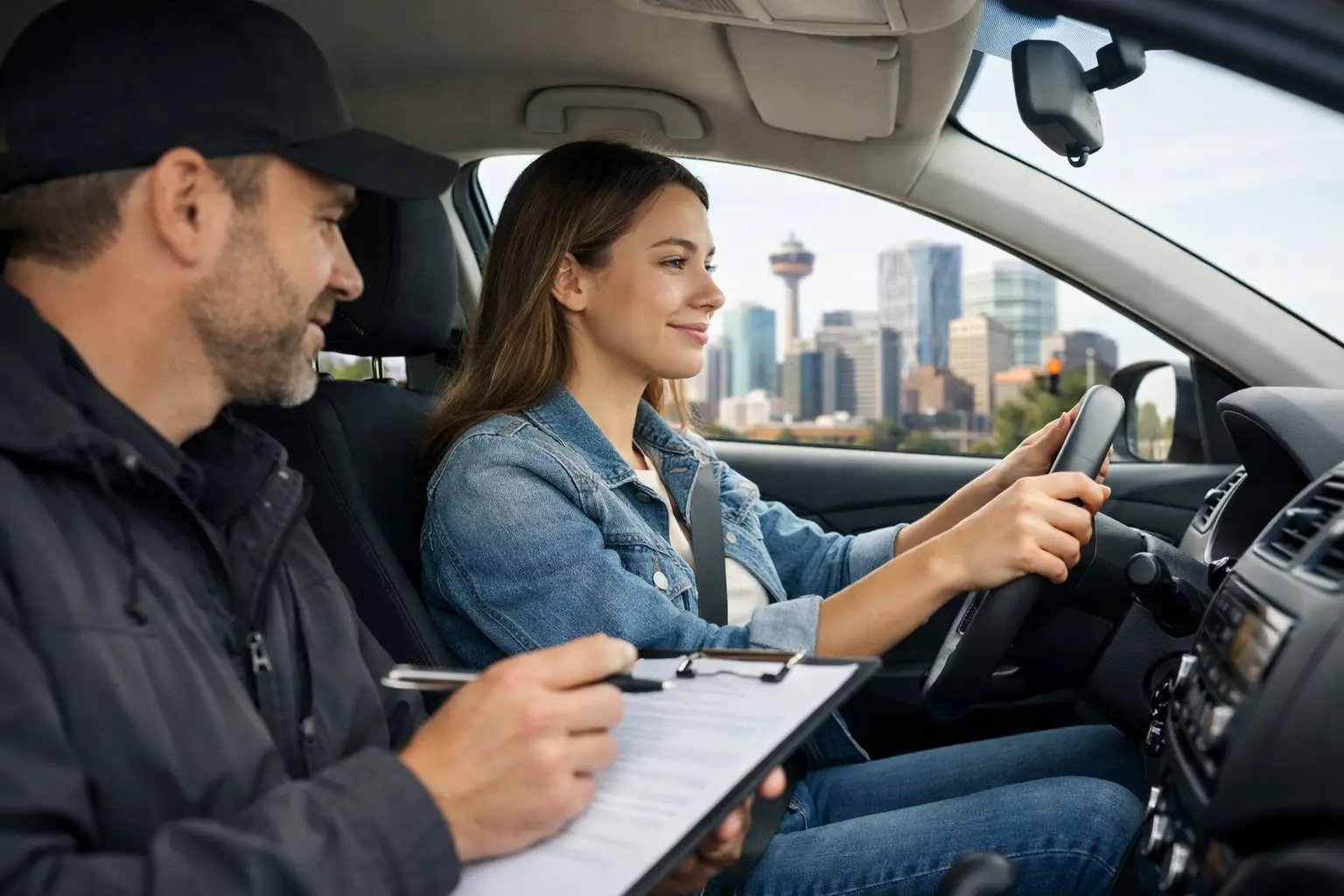
Your first time behind the wheel should not feel like being handed the keys and told to figure it out. If you are wondering what happens in driving lessons, expect a structured process that starts with control and awareness, then builds toward confident decisions in real Calgary traffic.
Professional lessons give new drivers a clear path from knowing the rules to applying them safely. You will work with an Alberta-licensed instructor, practice in a dual-control vehicle, receive direct feedback, and repeat essential skills until they become dependable habits. The goal is not simply to pass a road test. It is to become a safe, responsible driver for life.
What Happens in Driving Lessons, Step by Step
Every student begins at a different point. A new Class 7 driver may be learning the basic relationship between steering, braking, and speed. An adult with international driving experience may already be comfortable operating a vehicle but need to adjust to Alberta road rules, winter conditions, and local road-test expectations.
Your instructor should assess your starting point before moving through the lesson plan. At Turn by Turn Driving School, in-car instruction is delivered in focused two-hour lessons, which gives students enough time to settle in, practice a skill repeatedly, and receive useful coaching without becoming overwhelmed.
Before the vehicle moves
The first part of a lesson is usually spent getting properly set up. You will learn how to adjust the seat, head restraint, steering wheel, and mirrors so you can reach the pedals comfortably and see around the vehicle. You will also review dashboard controls, signals, wipers, defrosters, lights, and parking brake operation.
This may sound basic, but vehicle setup affects every decision that follows. A driver who sits too far back, has poorly adjusted mirrors, or cannot operate the defroster quickly is at a disadvantage before reaching the first intersection.
Your instructor will also explain the purpose of the dual controls. These allow the instructor to brake when necessary while you learn in real traffic conditions. They are a safety support, not a substitute for your responsibility. You are still learning to scan, predict, brake smoothly, and make sound choices.
Early lessons focus on vehicle control
For most beginners, the first driving time takes place on quieter residential roads or low-pressure areas. You will practice moving away from the curb, steering accurately, maintaining a steady position in your lane, and making controlled stops.
At this stage, the instructor is watching for more than whether the car moves forward. They are looking at where your eyes are directed, whether your hands are positioned for control, how gradually you use the brakes, and whether you understand what is happening around you.
You will also start building routines for turns and intersections. This includes checking mirrors, signaling early, reducing speed before the turn, checking for pedestrians and cyclists, choosing the correct lane position, and accelerating only when the vehicle is straight and the path is clear. These actions eventually need to work together, but they are learned one piece at a time.
Building Defensive Driving Habits
Driving lessons become more valuable as traffic conditions become more complex. Once you can control the vehicle on quieter roads, your instructor will introduce busier streets, multiple-lane roads, school zones, playground zones, roundabouts, railway crossings, and more demanding intersections.
The purpose is not to rush you into difficult situations. It is to expand your experience at a pace that supports safe learning. A good instructor increases the challenge when you are ready, then steps back when a skill needs more practice.
Defensive driving is central to this process. You will learn to look well ahead, identify hazards early, maintain safe following distance, and leave yourself space to respond if another driver makes an error. You will practice recognizing a vehicle that may turn unexpectedly, a pedestrian approaching a crosswalk, or a driver who is changing lanes without enough room.
Calgary drivers also need to be ready for changing conditions. Rain, snow, glare, icy intersections, and reduced visibility all affect braking distance and decision-making. You cannot control the weather or the behavior of other road users. You can control your speed, following distance, observation, and willingness to wait for a safe gap.
Parking, lane changes, and higher-speed roads
As your skill develops, lessons include practical tasks that many new drivers find stressful. Parking is one example. You may practice parallel parking, angle parking, hill parking, backing into a stall, and pulling out safely. The important part is not completing a parking maneuver quickly. It is checking your surroundings, moving slowly, and maintaining control throughout the maneuver.
Lane changes are another major lesson topic. Your instructor will teach a consistent process: check mirrors, signal, check the blind spot, confirm there is adequate space, move smoothly, and cancel the signal. Looking over your shoulder is essential because mirrors do not show every area beside the vehicle.
Higher-speed roads require a different kind of attention. You will work on joining traffic safely, matching an appropriate speed, maintaining a safe gap, and planning farther ahead. Some students need additional practice here, especially if most of their family practice has taken place in quiet neighborhoods. That is normal. Confidence should come from preparation, not from taking unnecessary risks.
Feedback Is Part of Every Lesson
A driving lesson is not a silent evaluation. Your instructor will provide coaching as you drive and review key points afterward. Feedback may cover a missed mirror check, late braking, incorrect lane position, or a good decision to wait rather than force a turn.
Clear feedback is how skills improve. You should know what you did well, what needs work, and what to practice before the next lesson. If a mistake occurs, the instructor should explain why it mattered and show you how to correct it. A mistake during supervised training is an opportunity to develop a safer habit.
Students often worry that an instructor expects perfection immediately. That is not the standard. The expectation is focus, willingness to learn, and steady progress. Some skills click quickly, while others require repetition. Parking may be easy for one student and challenging for another. A returning driver may need little help with steering but more support with Alberta right-of-way rules or road-test routines.
Classroom Learning and In-Car Practice Work Together
In-car lessons are stronger when they are supported by formal driver education. A self-paced 15-hour online classroom module allows students to study traffic laws, signs, sharing the road, collision avoidance, impaired driving risks, and responsible decision-making before or alongside their road practice.
The classroom portion explains the rules. The in-car portion teaches you how to apply them while real vehicles, pedestrians, traffic signals, and changing conditions demand your attention. Both matter. Knowing the rule for an uncontrolled intersection is different from recognizing one early enough to slow down, scan properly, and proceed safely.
For busy students, self-paced online learning also offers flexibility. You can complete modules around school, work, and family responsibilities, then use your in-car time for skills that require direct instruction and practical repetition.
How Lessons Prepare You for an Alberta Road Test
Road-test preparation is part of driving education, but it should not be the only focus. A road test checks whether you can operate safely and legally on the day of the exam. Your lessons should prepare you for that standard while also teaching habits that remain useful after you earn your license.
As your test approaches, your instructor may run a mock road test or practice routes and maneuvers commonly evaluated in Alberta. You will work on observations at intersections, speed control, lane selection, turns, parking, merging, and responding to examiner directions without losing focus on the road.
Practice tests can expose gaps that are easy to miss during casual driving. For example, you may handle a turn safely but forget a shoulder check before moving toward the curb. Or you may know the speed limit but reduce speed too late when entering a playground zone. Identifying those details before test day gives you time to correct them calmly.
Do not treat every lesson as a pass-or-fail score. The most prepared drivers are usually the ones who ask questions, practice between sessions when possible, and accept correction without letting one error shake their confidence.
What You Should Bring to a Lesson
Arrive with your valid learner’s license, appropriate footwear that lets you feel the pedals, and glasses or contacts if your license requires them. Avoid footwear that can slide off, catch on a pedal, or make precise braking difficult.
Come rested and ready to concentrate. Learning to drive uses more mental energy than most students expect, especially during the first few lessons. If you are nervous, say so. Your instructor can explain the plan, start in a lower-pressure area, and help you focus on the next safe action instead of every possible outcome.
Progress happens one well-practiced decision at a time. Show up ready to learn, give yourself permission to improve gradually, and let consistent instruction turn uncertainty into calm, controlled driving.
Comments are closed