



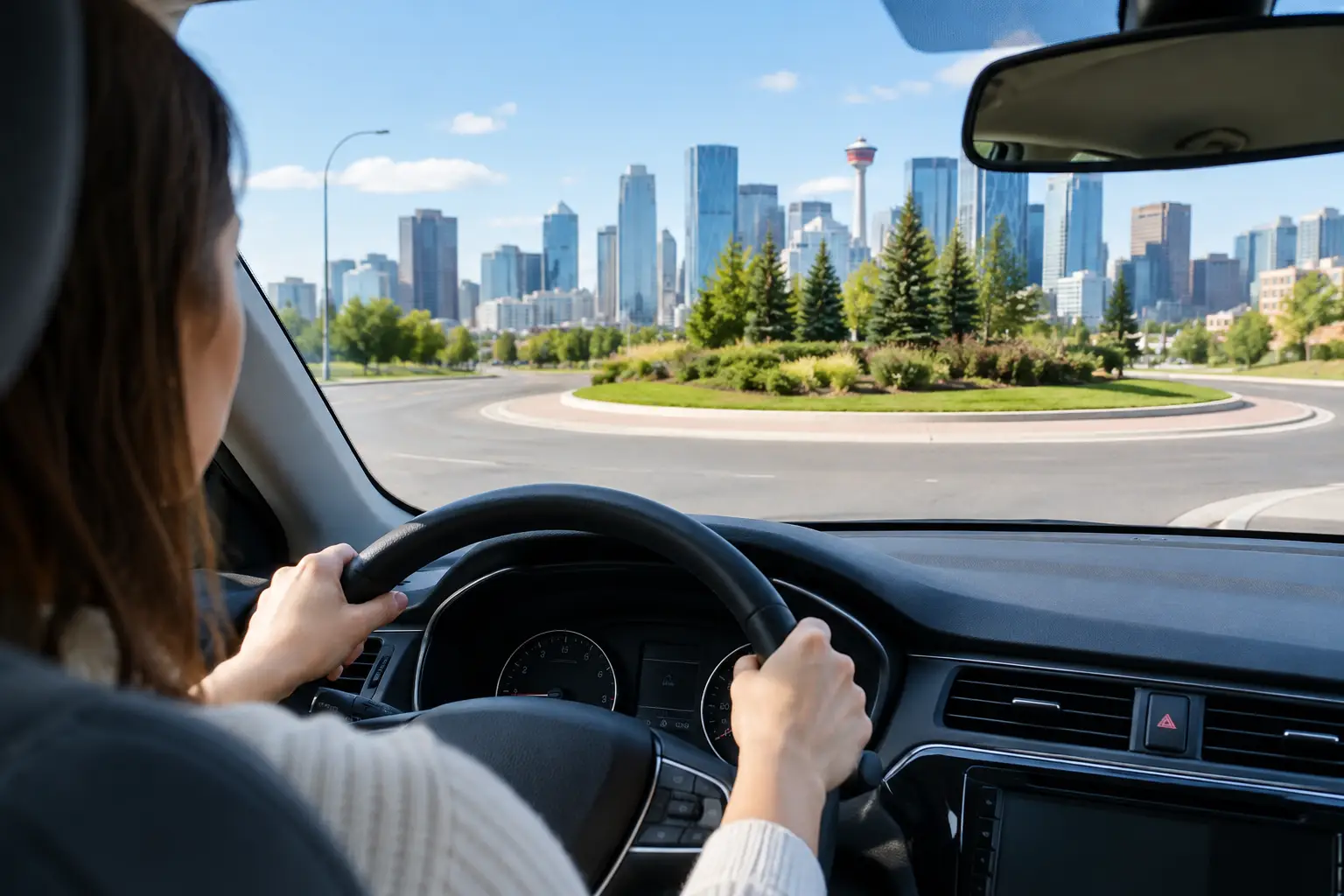
A roundabout can feel harder than a regular intersection because several decisions happen quickly: read the signs, choose a lane, watch for pedestrians, yield, enter, and signal your exit. The good news is that roundabouts are predictable when you approach them with a clear routine. These Calgary roundabout driving tips will help new, returning, and internationally licensed drivers handle them with safety and control.
Why Calgary Roundabouts Require a Different Approach
A traffic light tells drivers when to move. A roundabout asks drivers to make safe decisions based on traffic already in motion. The central rule is simple: vehicles entering the roundabout must yield to traffic circulating within it.
That does not mean stopping automatically. If there is a safe gap, continue smoothly into the correct lane. If there is not, slow down and wait at the yield line. Trying to force your way into a small gap creates risk for everyone around you.
Calgary drivers also need to account for changing conditions. Snow, ice, rain, low sun, and reduced visibility can make it harder to judge the speed and distance of circulating vehicles. In poor conditions, approach earlier and slower, leave more following distance, and do not accelerate sharply while turning through the circle.
Calgary Roundabout Driving Tips Before You Enter
Most roundabout errors begin before the vehicle reaches the yield line. Good preparation gives you more time to observe and make a calm decision.
Reduce Speed Early
Start slowing down as you see the roundabout warning sign, not at the last second. Scan for the yield sign, lane arrows, pavement markings, crosswalks, cyclists, and vehicles already circulating. A controlled approach lets you select the right lane without sudden braking or lane changes.
Keep your speed low enough that you can stop smoothly if a pedestrian steps into the crosswalk or traffic closes the available gap. Do not follow the vehicle ahead so closely that you lose your view of the entry lane.
Read the Lane Signs and Road Markings
Lane choice depends on the specific roundabout. A single-lane roundabout is straightforward: enter when clear, travel around the center island, and exit at your chosen street. Multi-lane roundabouts require more attention because lane assignments may vary.
Overhead signs, roadside signs, and painted arrows tell you which lane serves each exit. Read them before reaching the yield line. In general, the right lane often serves the first exit and through movements, while the left lane may be used for later exits or a U-turn. However, never rely on a general rule when the signs or pavement markings at that location say something different.
If you realize too late that you are in the wrong lane, do not cut across traffic. Continue through the roundabout in your lane and take a safe route to turn around later. Missing an exit is inconvenient. A sudden lane change is dangerous.
Check for Pedestrians and Cyclists
Pedestrians have a higher risk of being overlooked at roundabouts because drivers focus heavily on circulating traffic. Check each crosswalk as you approach and again as you prepare to exit. A person walking may be hidden behind the A-pillar or another vehicle until the last moment.
Cyclists may ride through the roadway or use crosswalk facilities, depending on the design and local conditions. Give them space, avoid passing them within the roundabout, and make your intentions clear through proper positioning and signaling.
How to Enter and Travel Through a Roundabout
Once you have selected the correct lane and checked that the entry is clear, enter smoothly. Keep your vehicle in its lane and follow the curve at a steady, controlled speed.
Yield to Traffic Already Circulating
Yielding means you wait for traffic in the roundabout that would conflict with your entry. Look to the left for vehicles approaching your entry point, but continue scanning ahead for pedestrians and for the path you will take.
Do not assume another driver will exit before reaching you unless their movement is clear and safe to rely on. Drivers sometimes signal late, signal incorrectly, or change their mind. Defensive driving means responding to what a vehicle is actually doing, not what you expect it to do.
When traffic is heavy, wait for a reasonable opening rather than trying to enter aggressively. The driver behind you may appear impatient, but the safe gap is your decision. A calm, legal entry is always the correct choice.
Stay in Your Lane
At a multi-lane roundabout, lane discipline matters. Keep both hands steady on the wheel, follow your lane markings, and avoid drifting toward the center island or outside lane. Do not change lanes inside the roundabout unless markings specifically guide that movement and it can be completed safely.
Large trucks, buses, and emergency vehicles need extra room. A truck may use part of another lane or the raised truck apron near the center island to complete its turn. Give it room and do not try to pass it within the circle.
If an emergency vehicle approaches with lights and sirens, do not stop inside the roundabout if you can avoid it. Continue to your exit, then pull over safely when possible. Stopping in the circulating lane can block the intersection and create confusion.
Signal Clearly When You Exit
You generally do not need to signal when entering a roundabout. Your lane choice and the road design communicate your intended path. As you approach your exit, signal right to show that you are leaving the circle.
Signal early enough for drivers, cyclists, and pedestrians to understand your intention, but not so early that it appears you plan to take an earlier exit. In a small roundabout, this may mean activating your right signal shortly after passing the exit before yours. In a larger roundabout, you may have more distance and time.
After exiting, check the crosswalk immediately. This is one of the most common places for drivers to focus on traffic ahead and miss a pedestrian crossing the roadway. Maintain a low speed until you have cleared the crosswalk and entered the new road safely.
Common Mistakes That Create Risk
Roundabouts work best when every driver is predictable. These errors make the situation less predictable and should be avoided:
- Entering without yielding to circulating traffic.
- Stopping at an empty yield line when there is a safe gap to proceed.
- Choosing a lane late or crossing lanes to reach a missed exit.
- Failing to check crosswalks on entry and exit.
- Driving too fast for the curve, weather, or traffic conditions.
- Forgetting to signal right before exiting.
For new drivers, hesitation is often a bigger concern than lack of knowledge. Hesitation can be safe when it means waiting for a genuine traffic conflict. It becomes a problem when a driver stops unpredictably despite having a clear path. Build the habit of scanning, deciding, and proceeding smoothly when conditions allow.
Practice Roundabouts for Your Alberta Road Test
A road test examiner is not looking for perfection at every intersection. They are looking for safe observation, proper speed control, lane discipline, yielding behavior, and clear communication with other road users.
Before your Class 5 road test, practice different types of roundabouts. Begin with a quiet single-lane location, then progress to busier intersections and multi-lane designs. Practice taking the first exit, traveling straight through, taking later exits, and safely recovering when you choose the wrong lane.
Narrating the process during practice can help anxious drivers organize their thinking: “Slow down, read the arrows, check the crosswalk, yield left, enter when clear, stay in lane, signal right, check the exit crosswalk.” With repetition, those steps become a natural driving routine rather than a checklist you have to recite.
An instructor can also identify habits that are difficult to notice on your own, such as approaching too fast, looking only left, braking too late, or signaling at the wrong time. At Turn by Turn Driving School, in-car lessons focus on the defensive driving decisions that support safe, responsible driving long after the road test is complete.
The next time a roundabout appears ahead, give yourself space to prepare. Slow down early, follow the posted lane guidance, yield patiently, and make your exit clear. Confidence comes from repeating the right process until it feels controlled and familiar.
Comments are closed