



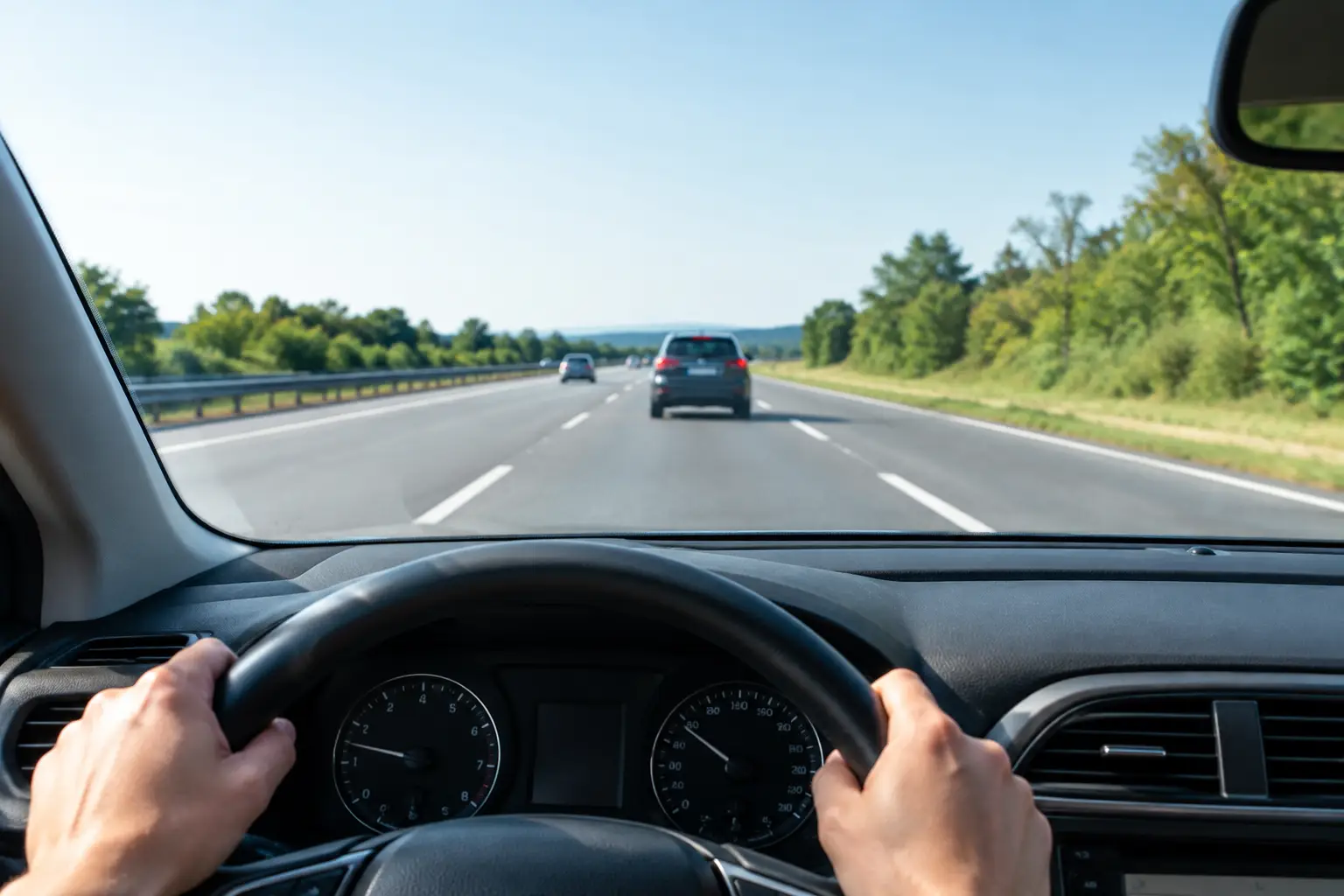
A lane that feels narrow usually is not the real problem. New drivers often look too close to the front of the vehicle, tense their hands on the wheel, and make small corrections that move the car from side to side. To improve lane positioning, you need a steady visual routine, smooth steering, and enough awareness to keep your vehicle centered while still watching for hazards.
Good lane position is not about driving over an imaginary line in the exact middle of the road. It is about giving yourself space, protecting other road users, and staying in control as the road changes. That is a core defensive-driving skill for daily Calgary driving and for the Class 5 road test.
What Proper Lane Positioning Looks Like
In a normal travel lane, your vehicle should sit near the center of the lane with safe space on both sides. You should not feel like you are following the left or right line. Instead, the lane should appear balanced through the windshield as you look well ahead.
Your exact position may change slightly based on conditions. A parked vehicle, cyclist, pedestrian near the curb, large truck, pothole, or narrow construction lane can require more space on one side. The goal is not to hold one rigid position. The goal is to choose the safest available space while remaining predictable to traffic around you.
Keep in mind that drivers sit on the left side of the vehicle. Because of that, many beginners believe they are centered when the vehicle is actually too close to the left lane line. Others overcorrect to the right and drift toward curbs, parked cars, or shoulder debris. Learning what centered feels and looks like takes focused practice.
Look Far Ahead Instead of at the Lane Lines
The most effective way to improve lane positioning is to change where you look. Looking directly in front of the hood gives you very little time to process the road and encourages constant steering corrections. Your hands follow your eyes, so a close focus often makes the vehicle wander.
Aim your vision well down the road, ideally toward where you expect to be 12 to 15 seconds ahead. On city streets, that may mean looking beyond the next intersection. On faster roads, look farther ahead while continuing to scan mirrors, signs, traffic lights, and the space around your vehicle.
Use the lane lines as part of your peripheral vision, not as your main target. When your eyes are up, you can notice whether the lane appears equally spaced around your vehicle. If it does not, make one small, smooth adjustment. Avoid repeatedly moving the wheel back and forth. Large or frequent corrections are more noticeable to other drivers and can reduce your control.
Use Safe Visual References
Visual references can help learners understand where the vehicle sits in the lane. They are not permanent rules because vehicle size, seating position, road shape, and driver height all vary. Still, they provide a useful starting point.
As you drive straight, notice where the right lane line appears through the lower area of your windshield. Notice the same relationship with the left line. With an instructor, you can confirm whether the car is actually centered and connect that real-world position to what you see from the driver’s seat.
Do not stare at a reference point. Check it briefly, then return your focus down the road. The purpose is to develop judgment, not to create a habit of watching the pavement immediately in front of your car.
Keep Your Steering Inputs Smooth
Correct seating and hand position make lane control easier. Sit high enough to see the road clearly, with your back supported and your wrists able to rest near the top of the steering wheel when your arms are extended. Sit close enough that you can turn the wheel without locking your elbows or leaning forward.
Hold the wheel securely with both hands in a balanced position, commonly around 9 and 3. This gives you better control than resting one hand at the top of the wheel or gripping the wheel tightly with both hands. A rigid grip often leads to rigid steering.
When you notice that you are slightly off-center, use a small steering input and let the vehicle settle. Do not snap the wheel back. A helpful rule is to correct early and gently. If you wait until you are close to a lane line, you may feel pressured to make a larger movement than necessary.
Speed also affects positioning. At higher speeds, a vehicle reacts more quickly to every steering input. If you are struggling to stay centered, check your speed. Slowing to a safe, legal speed can give you more time to look ahead and make controlled adjustments.
Adjust Your Position for Real Road Conditions
Centered is usually the starting point, not the only correct answer. Defensive drivers adjust their lane position when a hazard changes the available space.
When passing parked cars, leave enough room for an opening door or a person stepping out from between vehicles. If it is safe and legal, you may position slightly left within your lane. Do not cross the center line or move into another lane without checking mirrors, signaling, and ensuring the lane is clear.
When driving beside a large truck or bus, avoid staying beside it longer than necessary. These vehicles can limit your visibility, create wind movement, and need extra room to turn. Maintain a safe following distance, pass only when conditions allow, and avoid hugging the lane line nearest the larger vehicle.
In rain, snow, slush, or icy conditions, lane markings may be difficult to see. Reduce speed, increase following distance, and use the path of traffic ahead only as one source of information. Do not follow another vehicle so closely that you lose your own view of the road. On narrow, snow-covered streets, identify where the road edges, parked cars, mailboxes, and oncoming traffic are likely to be before choosing your path.
Construction zones require extra patience. Lanes may narrow, shift, or have temporary markings that conflict with old paint. Follow the current signs and markings, reduce speed, and keep your eyes ahead. If you are uncertain, do not make abrupt moves. A calm, predictable driver is safer than one who reacts at the last second.
Lane Positioning Through Curves and Turns
Many drivers drift wide in curves because they look at the curb, median, or oncoming lane rather than through the curve. Turn your eyes toward the path you want the vehicle to follow. Looking through the curve helps your hands guide the vehicle smoothly.
Enter curves at a safe speed before you begin turning. Braking hard in the middle of a curve can upset the vehicle’s balance, especially on wet or icy pavement. Maintain steady control and accelerate gently only when you can see the road opening ahead.
At intersections, complete turns into the correct lane. A right turn normally finishes in the nearest available lane, while a left turn should be completed into the appropriate lane for your direction of travel, following signs, markings, and road design. Do not swing wide into another lane simply because it feels easier. During a road test, lane discipline during turns is closely observed because it shows whether you can control your vehicle around other traffic.
Practice a Simple Lane-Control Routine
Improvement comes from deliberate repetition, not from trying to correct every mistake at once. Begin on quieter roads where you can focus without heavy traffic pressure. Drive a familiar route and use the same routine: look far ahead, scan mirrors regularly, check your lane space with peripheral vision, and make smooth corrections when needed.
After each short drive, identify one pattern. Were you drifting right when watching parked cars? Did you move left when an oncoming vehicle approached? Did your steering become tense at higher speeds? A specific observation gives you a clear skill to practice during the next lesson.
Parking-lot practice can also help you understand vehicle width, but it cannot replace on-road instruction. Real streets add traffic, lane markings, curves, intersections, cyclists, and changing conditions. Structured in-car lessons give you immediate feedback on whether your visual references and corrections are actually keeping the vehicle in a safe position.
For nervous or returning drivers, start with calm routes and build up to busier roads. Confidence should come from repeatable habits, not from rushing into situations before your vehicle control is ready.
A centered vehicle begins with a calm driver who looks ahead, leaves room for hazards, and trusts small, deliberate steering movements. Give yourself time to practice that routine, and each drive will feel more controlled than the last.
Comments are closed