



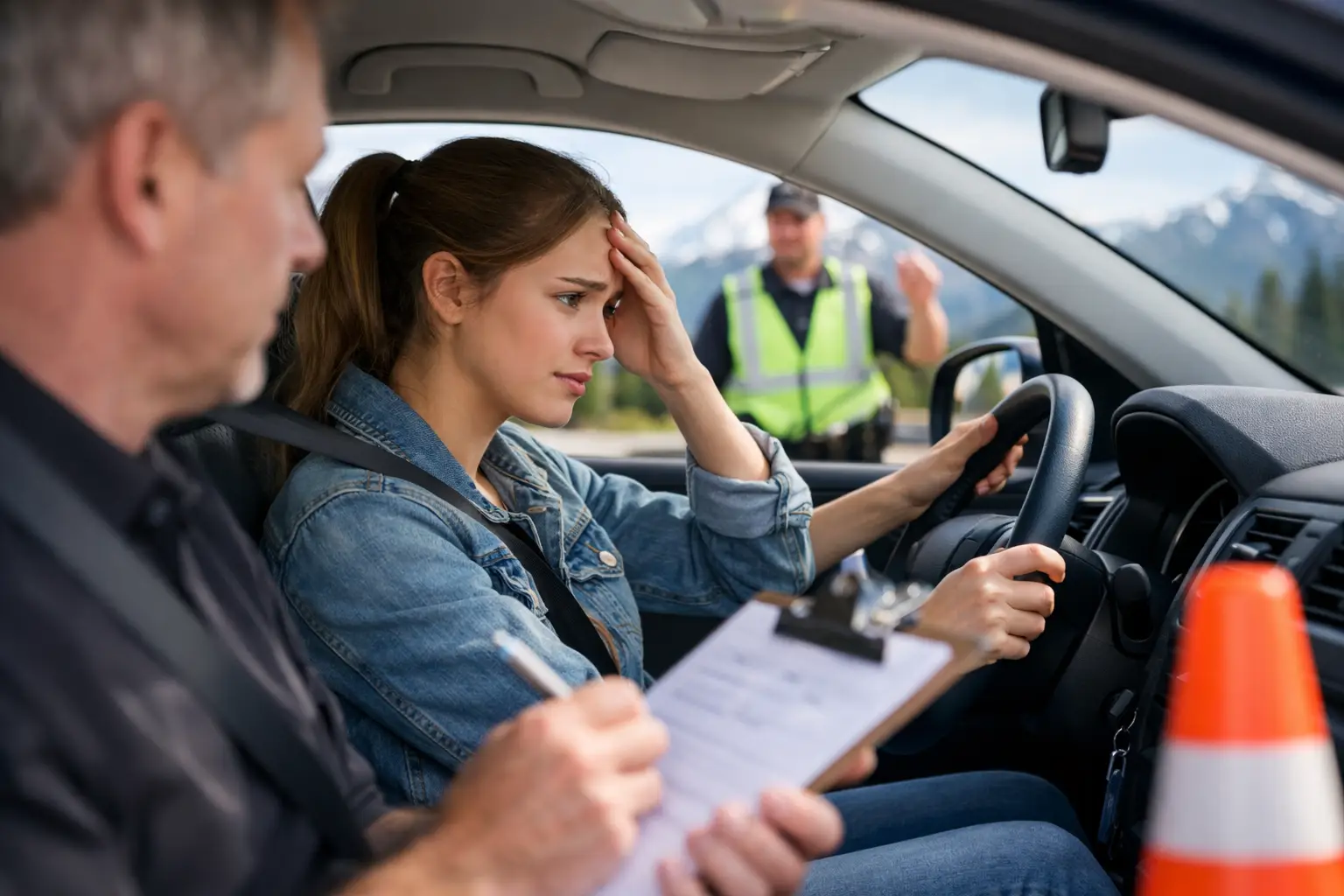
A road test usually goes wrong before the examiner says a word. It happens when a driver rolls a stop, forgets a shoulder check, turns too wide, or lets nerves rush a simple decision. The good news is that most alberta road test common mistakes are predictable, which means they can be corrected with focused practice before test day.
Many students assume the test is looking for perfection. It is not. Examiners are looking for safe, legal, controlled driving. That standard matters whether you are a new driver moving from Class 7 to Class 5 GDL, an adult returning to driving, or an internationally licensed driver adjusting to Alberta rules and road habits. If you understand the mistakes that show up most often, you can train with a clear purpose instead of hoping your practice is enough.
Why common road test errors happen
Most test mistakes come from one of three problems. The first is incomplete observation. A driver may know they should check mirrors and blind spots, but under pressure they miss a step or do it too late. The second is poor speed and space control. That includes driving too fast for conditions, creeping too slowly without reason, following too closely, or misjudging a turn. The third is stress. Nervous drivers often know the right action, but they rush through it.
This is why structured training matters. Random practice can build familiarity, but it does not always build repeatable habits. Safe drivers learn a sequence, apply it the same way each time, and stay composed when traffic changes around them.
Alberta road test common mistakes at intersections
Intersections are where many road tests are won or lost. They combine observation, timing, lane control, right-of-way, and speed management in a short space.
One of the biggest errors is rolling through stop signs. A complete stop means the vehicle fully stops behind the stop line, crosswalk, or curb edge if no line is visible. Many drivers slow down enough to feel in control and think that counts. It does not. Examiners notice this immediately because it is both a legal and safety issue.
Another frequent mistake is poor scanning. Some drivers look left and right, but too quickly to actually assess hazards. Others look once and then move without rechecking. At a busy intersection, conditions change fast. A pedestrian can step off the curb, a vehicle can turn unexpectedly, or traffic can close a gap.
Turning errors are also common. Left turns often go too wide or cut into the wrong lane. Right turns may drift out instead of staying tight and controlled. Many test candidates also forget to check for pedestrians before turning, especially when they are focused on vehicle traffic.
If an intersection has an amber or yellow light, indecision causes problems. Hard braking when it is safer to continue, or accelerating late to beat the light, both show poor judgment. The key is to make an early, controlled decision based on distance, speed, and traffic behind you.
Observation mistakes that cost marks fast
When students ask what examiners notice first, the answer is usually observation. Strong observation is visible. It is timely, deliberate, and consistent.
The most common issue is missing shoulder checks. In Alberta, shoulder checks are expected before lane changes, when moving away from the curb, and in many turning situations where cyclists, pedestrians, or adjacent traffic may be present. Some drivers do a quick head movement that looks more like a habit than a real check. If you are not actually clearing the blind spot, the motion alone will not help.
Mirror use matters too. Drivers should not stare at mirrors, but they should monitor them regularly and especially before slowing, changing position, or reacting to traffic. A driver who brakes suddenly without first checking what is behind them shows weak situational awareness.
Pedestrian observation is another area where otherwise capable drivers lose points. School zones, residential streets, parking lots, and downtown areas all demand extra attention. If you only scan for cars, you are not scanning enough.
Speed control and following distance problems
Many people think speeding is the only issue. In reality, inconsistent speed is just as risky during a test. Driving under the limit without a reason can signal uncertainty and disrupt traffic flow. Driving slightly over the limit, especially in playground or school areas, is even more serious.
Good speed control is about matching the posted limit, road conditions, visibility, and traffic pattern. That means staying alert when a limit changes and adjusting smoothly rather than abruptly. It also means recognizing when winter conditions, rain, glare, or congestion call for more space and less speed even if the sign allows more.
Following too closely is another repeated problem. Under stress, drivers tend to focus only on the vehicle ahead and forget the space needed to react. A proper following distance gives you time to brake gradually and shows the examiner that you are planning ahead instead of just responding at the last second.
Parking and low-speed control errors
Parking feels smaller than intersection driving, but examiners still look for precision and safety. Parallel parking, hill parking, and pulling in or out of a stall all test your control of the vehicle and your observation habits.
A common mistake is focusing only on the final position and forgetting the safety checks before moving. Before backing up, pulling out, or adjusting your vehicle, you still need mirrors, shoulder checks, and awareness of people or vehicles nearby. Another issue is poor steering control at low speed, which can lead to overcorrection, touching a curb, or ending far from the curb when parallel parking.
Hill parking is often memorized but not understood. Drivers may remember to turn the wheel but forget why, or they mix up the direction based on uphill or downhill position. When you understand that the wheel placement helps stop the vehicle from rolling into traffic if the brakes fail, the steps become easier to remember and apply correctly.
Vehicle handling mistakes tied to nerves
Some alberta road test common mistakes are not about knowledge at all. They happen because the driver is tense.
Nervous drivers often grip the wheel too tightly, brake too late, accelerate too suddenly, or hesitate so long that a safe gap disappears. They may also stop twice at the same intersection because they are second-guessing themselves, or miss an instruction because they are replaying a previous mistake in their head.
The fix is not to tell yourself to relax. The fix is to rely on routines. If every lane change follows the same pattern, and every stop sign follows the same pattern, your body has something solid to return to when stress rises. Confidence is usually the result of repetition, not personality.
How to practice the right way before test day
The strongest preparation is specific. Instead of driving around for an hour and calling it practice, choose the exact skills that cause the most test failures and repeat them until they are automatic.
Spend one practice session on stop signs and intersection scanning. Spend another on lane changes, shoulder checks, and merging. Use another for parallel parking, hill parking, and backing control. Then combine them in a full mock drive where someone gives directions with minimal notice, just like an examiner would.
It also helps to practice in different conditions. Daylight driving is not the same as afternoon traffic. Quiet residential streets are not the same as busier commercial roads. If you are new to Alberta, local road design, speed transitions, and winter conditions may require extra adjustment time.
Professional instruction can shorten that learning curve because feedback is immediate and structured. At Turn by Turn Driving School, that is exactly how we prepare students – by turning weak spots into repeatable habits, not by hoping experience alone will cover the gaps.
What to do on the day of your road test
Treat the test like a regular drive with a higher standard of consistency. Arrive early, know your documents, and make sure the vehicle is clean, legal, and working properly. If you start the test already rushed, your decision-making gets worse.
During the drive, listen carefully and ask for clarification if you did not hear an instruction. That is better than guessing. If you make a small mistake, keep going. One imperfect moment does not automatically mean failure, but losing focus after it can create a second and third mistake.
Most of all, let your driving show the examiner that you are safe, observant, and in control. That is the standard that matters long after the test is over. Build for that standard now, and the pass result becomes much more likely.
Comments are closed