



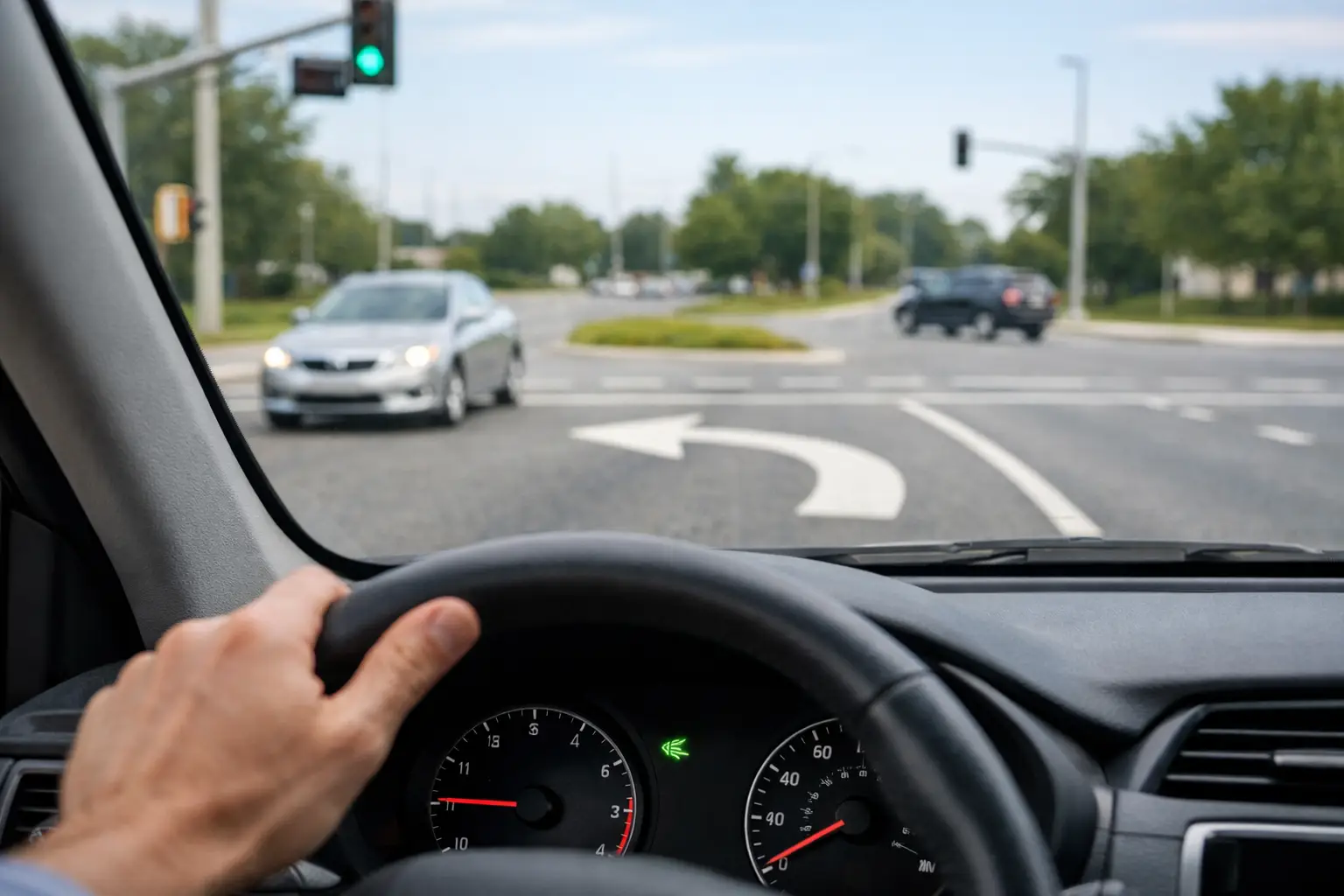
A left turn can take only a few seconds, but it asks you to judge speed, distance, traffic gaps, pedestrians, signals, and lane position at the same time. That is why making safe left turns is a core skill for new drivers, returning drivers, and anyone preparing for a road test. The goal is not to rush through the intersection. The goal is to make a calm, legal decision and complete the turn with control.
Why Left Turns Require More Attention
A left turn usually crosses the path of oncoming traffic. Unlike a right turn, you may need to wait for a safe opening while vehicles approach from the opposite direction. You must also watch for people crossing the street, cyclists traveling beside traffic, vehicles turning from side streets, and changing traffic lights.
The most common problem is not a lack of steering ability. It is poor decision-making under pressure. A driver may feel rushed by vehicles behind them, misjudge the speed of an oncoming vehicle, or focus only on cars and miss a pedestrian in the crosswalk. Defensive driving means accepting that waiting is sometimes the safest and most responsible choice.
Set Up for the Turn Before You Reach the Intersection
Safe turns begin well before the corner. As you approach the intersection, identify whether you are in a dedicated left-turn lane, a shared lane, or a regular lane where a left turn is permitted. Move into the correct lane early and smoothly. Avoid sudden lane changes near the intersection.
Signal early enough to communicate your plan to drivers behind you. Check your mirrors before slowing down, then reduce speed gradually. If the road has a marked left-turn lane, enter it when it is safe and follow the lane markings. Position your vehicle so you are ready to turn without drifting into an adjacent lane.
At this stage, scan ahead for the traffic-control device. A green arrow generally gives protected movement for the turn, while a solid green light may require you to yield to oncoming traffic and pedestrians. A yellow signal means the light is changing, not that you should accelerate into the intersection. If you cannot complete the turn safely, prepare to stop.
Scan the Entire Intersection
Do not look only at the first oncoming car. Scan from left to right and back again. Check for approaching vehicles, pedestrians at both corners, cyclists, and vehicles that may enter late from a side street or driveway.
Pay close attention to vehicles with their right-turn signal on. A signal can be helpful, but it is not a guarantee that the driver will turn. Wait until the vehicle actually begins its turn or until you have a gap that is safe even if that driver continues straight. This small habit prevents many serious intersection collisions.
Making Safe Left Turns on a Green Light
When the signal is green without a protected arrow, you may enter the intersection if it is clear to do so and if local rules allow it. Keep your wheels pointed straight while waiting. Turning your wheels left before you begin the turn creates a risk: if a vehicle hits you from behind, your vehicle could be pushed into oncoming traffic.
Wait for a gap that gives you enough time to cross the oncoming lanes and enter the correct lane on the new road. A safe gap depends on several factors, including the speed of approaching vehicles, road conditions, visibility, the width of the intersection, and your vehicle’s acceleration. Rain, snow, darkness, glare, and wet or icy pavement all require a larger safety margin.
When the path is clear, check the crosswalk one final time. Then accelerate smoothly, steer through the turn, and enter the nearest legal lane for your direction of travel unless signs or lane markings direct otherwise. Avoid swinging wide into a farther lane. A controlled turn should feel deliberate, not sharp or rushed.
If the light turns yellow or red while you are already waiting legally within the intersection, complete your turn only after oncoming traffic and pedestrians have cleared. Do not stop in the middle of the intersection if you can safely leave it. At the same time, never force your way through a closing gap. Your decision must still protect everyone using the intersection.
Protected Left Turns and Advanced Green Arrows
A green arrow is designed to separate your movement from conflicting traffic. It reduces risk, but it does not remove your responsibility to scan. Before turning, check the crosswalk and look for pedestrians, cyclists, or a driver who has entered the intersection unexpectedly.
Use the arrow promptly but calmly. Hesitating too long can disrupt traffic, yet rushing can lead to a wide turn or missed hazard. Start from the correct lane, keep a steady speed, and finish in the correct lane. When the arrow ends, do not assume you still have the right-of-way. Look at the signal that remains and follow it.
Left Turns at Stop Signs and Uncontrolled Intersections
At a stop sign, come to a complete stop at the stop line. If there is no visible line, stop before the crosswalk. If there is no crosswalk, stop before entering the intersection where you can see approaching traffic clearly without blocking pedestrians.
After stopping, scan for traffic from every direction. Yield to vehicles already in or approaching the intersection closely enough to create a hazard. Yield to pedestrians and cyclists as well. At four-way stops, the first vehicle to stop is generally the first to proceed, but never rely on another driver to follow that rule perfectly. When in doubt, communicate with eye contact only when possible, wait, and proceed when the path is clearly safe.
Uncontrolled intersections require even more caution because there may be no signs or signals to organize traffic. Reduce speed early, cover the brake, and be prepared to yield. Limited sight lines from parked vehicles, trees, buildings, or snowbanks can hide approaching road users until the last moment.
Common Errors That Can Cost You on a Road Test
Road-test examiners look for safe observation, legal right-of-way decisions, speed control, and proper lane placement. A technically smooth turn can still be marked down if you fail to check a crosswalk or turn into the wrong lane.
Avoid these frequent errors:
- Entering an intersection too quickly and having to brake hard while turning.
- Accepting a gap that leaves oncoming traffic braking or swerving.
- Cutting across lanes or finishing in the incorrect lane.
- Turning without checking for pedestrians and cyclists.
- Following another vehicle through the intersection without independently confirming the path is clear.
The last error deserves special attention. If the vehicle ahead turns left, that does not mean you have a safe gap. Their view, speed, and decision may differ from yours. Make every left turn based on your own observations.
Build Confidence Through Deliberate Practice
Confidence comes from repeating the right process, not from taking chances. Start practicing in quieter intersections where you can focus on lane position, signaling, complete stops, and smooth steering. Then move to busier intersections with protected arrows, multiple lanes, pedestrians, and heavier traffic.
During practice, say the steps quietly to yourself: mirror check, signal, correct lane, scan, yield, crosswalk check, turn into the nearest lane. This can help new drivers organize their attention until the routine becomes natural. A qualified instructor can also identify habits that are difficult to notice from the driver’s seat, such as looking too briefly for hazards or beginning the turn from poor lane position.
Turn by Turn Driving School teaches left turns as part of a larger defensive-driving approach: observe early, create time and space, and make decisions you can carry out safely. The best left turn is rarely the fastest one. It is the one that leaves every road user with enough room, enough time, and no reason to react suddenly.
The next time you approach a left turn, give yourself permission to wait for the safer gap. That single decision builds the judgment expected of a safe, responsible driver for life.
Comments are closed