



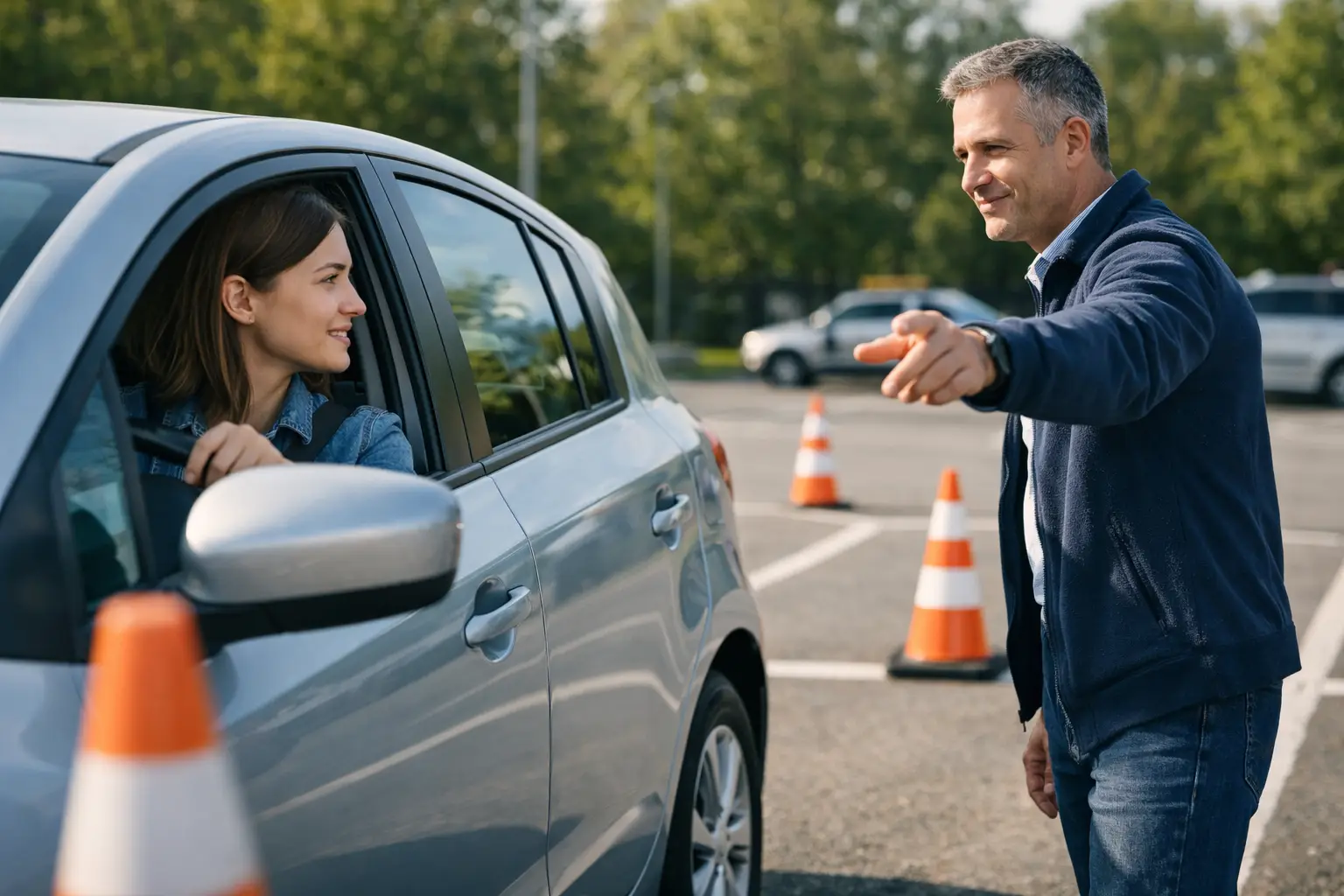
A parking space can feel far smaller from the driver’s seat than it looks from outside. That is why the best parking lesson tips beginners can follow are not about memorizing one perfect steering point. They are about slowing down, using clear observations, and controlling the vehicle one movement at a time. Those habits make parking safer in a quiet lot, a busy Calgary shopping center, or during an Alberta road test.
Start With Control, Not Speed
Parking is low-speed driving, but it still demands full attention. Most beginner parking errors happen because the driver turns too sharply, reverses too quickly, or focuses on the curb while forgetting to check for people and vehicles around them.
Before moving into any space, set up your position. Sit high enough to see clearly over the steering wheel, adjust your mirrors, fasten your seat belt, and keep both hands ready to steer. Use smooth brake pressure and allow the vehicle to creep when possible. If the vehicle begins moving faster than you intended, stop, reset, and continue only when you have control.
A controlled stop is never a failure. In a driving lesson or road test, taking a moment to assess the space shows sound judgment. Rushing to complete the maneuver is more likely to create a curb strike, an unsafe correction, or a missed observation.
Build a Consistent Observation Routine
Parking requires more than looking in the direction you plan to travel. You need to identify vehicles, pedestrians, cyclists, shopping carts, posts, snowbanks, and open doors before they become a problem.
When preparing to park, scan the space ahead and the traffic behind you. Signal early enough that other drivers understand your plan. As you reverse, check the rear window directly while also using mirrors to monitor the sides of the vehicle. Mirrors support your view, but they do not replace a proper shoulder check and direct rearward observation.
In a busy parking lot, pedestrians may appear from between parked vehicles with little warning. Move slowly enough that you can stop immediately. This is especially important near schools, recreation centers, stores, and residential streets where children and pedestrians may not expect a reversing vehicle.
Know When to Pause
If someone walks behind your vehicle, stop and wait. Do not assume they will move out of the way, and do not try to complete the maneuver before they reach your path. The same rule applies if another vehicle begins backing out nearby. Give space, keep watching, and proceed only when the area is clear.
Parking Lesson Tips for Beginners: Use Reference Points Carefully
Reference points can help new drivers understand vehicle position. For example, an instructor may show you when to begin turning for a stall or how a line appears in a mirror when the vehicle is centered. These visual cues are useful during early practice because they turn a confusing task into repeatable steps.
However, reference points are not universal. The size of the vehicle, seat position, parking-space layout, curb height, and slope can all change what you see. Treat a reference point as a starting guide, not a replacement for observation and judgment.
A better long-term goal is learning to recognize the vehicle’s path. As you turn the steering wheel, notice how the front of the vehicle swings outward and how the rear follows. This awareness matters in angled stalls, tight parallel parking spaces, and underground lots with pillars close to the travel lane.
Practice Forward Stall Parking First
Forward stall parking helps beginners develop steering control and space awareness. Choose an empty section of a parking lot so you have room to correct safely. Approach the stall slowly, stay far enough from the row of parked vehicles to make the turn without cutting across the line, and look through the space toward where you want the vehicle to finish.
Turn smoothly into the stall and straighten the wheels as the vehicle becomes parallel with the lines. Stop before the front bumper reaches a curb, barrier, or snowbank. Then check both sides. You should be centered enough that passengers can open doors without striking the vehicle beside you.
If you enter crooked, do not try to force a last-second correction with a sharp steering movement. Back out slowly, observe carefully, and set up again. Resetting is often safer than making a tight correction in a limited space.
Backing Out Is Part of the Skill
Many drivers focus on getting into the stall and forget that backing out has its own risks. Before reversing, look around the vehicle, check mirrors, signal if appropriate, and reverse at a walking pace. Continue looking through the rear window, checking side areas as needed.
Once the front of your vehicle begins to clear the vehicles beside you, pause if visibility is limited. Look for cross traffic before completing the exit. A parking lot lane is still an active roadway, and other drivers may not anticipate your movement.
Learn Reverse Stall Parking for Better Visibility
Reverse stall parking may feel harder at first, but it often gives you a safer exit because you drive forward into the traffic lane when leaving. It is particularly useful in crowded lots, locations with heavy pedestrian activity, and spaces where backing out would leave you with poor visibility.
Start by positioning your vehicle so there is enough room to turn into the stall. Signal, check for traffic and pedestrians, and move slightly forward of the space before beginning to reverse. Look behind you, reverse slowly, and steer into the stall with calm, deliberate movements. Straighten the wheels as the vehicle aligns with the parking lines.
Do not rely only on a backup camera. A camera can help you see directly behind the vehicle, but it may not show approaching pedestrians or traffic in side areas. During lessons and road test preparation, use the camera as an additional aid while maintaining direct observation and mirror checks.
Approach Parallel Parking as a Sequence
Parallel parking is usually the maneuver that creates the most anxiety, especially when traffic is waiting. The answer is not to hurry. Use a clear sequence: identify a space that is reasonably larger than your vehicle, signal, stop beside the vehicle ahead, check your surroundings, and reverse slowly while steering in stages.
Your goal is to finish close enough to the curb without touching it, centered between the vehicles ahead and behind. If the vehicle is too far from the curb or not straight, make a safe correction. On a road test, a thoughtful correction is generally better than accepting poor final position.
It depends on the location and road conditions. A dry, open street gives you more margin than a narrow street with snow-packed curbs, moving traffic, or poor visibility. In winter, curbs and lane edges may be hidden. Reduce speed further, leave additional space, and never assume a snowbank marks the true edge of the roadway.
Avoid the Habits That Create Parking Mistakes
Good parking is built through repeatable habits. Avoid these common mistakes:
- Turning the wheel while moving too quickly, which makes the vehicle harder to control.
- Looking only at lines or curbs instead of checking the full area around the vehicle.
- Reversing on mirrors alone rather than looking through the rear window.
- Forgetting to signal before pulling toward a parking space or curb.
- Leaving the wheels turned after parking, especially when parked on a hill.
- Continuing with a maneuver when the space no longer looks safe or clear.
The solution is usually simple: slow down, stop if needed, observe again, and make one correction at a time.
Practice With a Purpose
Random parking practice can build repetition, but structured practice builds judgment. Begin in an empty lot with forward and reverse stalls. Then progress to busier lots, tighter spaces, angled stalls, curb parking, and parallel parking on quiet residential streets. Add real-world conditions gradually, such as evening light, rain, or winter visibility, only when you can demonstrate steady control in easier settings.
A qualified instructor can identify details that are difficult to notice on your own, including late mirror checks, poor setup distance, rushed steering, and incomplete blind-spot checks. At Turn by Turn Driving School, in-car lessons are designed to connect safe vehicle control with defensive driving habits, so students can make decisions confidently rather than depend on guesswork.
Prepare for Road Test Parking Expectations
During an Alberta road test, the examiner is watching more than whether the vehicle ends inside the lines. They assess your observations, speed control, signaling, vehicle position, and ability to respond safely when conditions change. A technically neat park does not outweigh a missed pedestrian check or an unsafe reverse movement.
Practice parking under the same standards you will use on test day. Complete shoulder checks, signal correctly, control your speed, and secure the vehicle when finished. When parking on a hill, follow the appropriate wheel position and use the parking brake as required. These small routines show that you are preparing to be a safe, responsible driver for life, not simply completing a maneuver.
The next time a parking space makes you tense, give yourself permission to slow down. A calm setup, complete observation, and safe correction will take you further than trying to park perfectly on the first attempt.
Comments are closed