



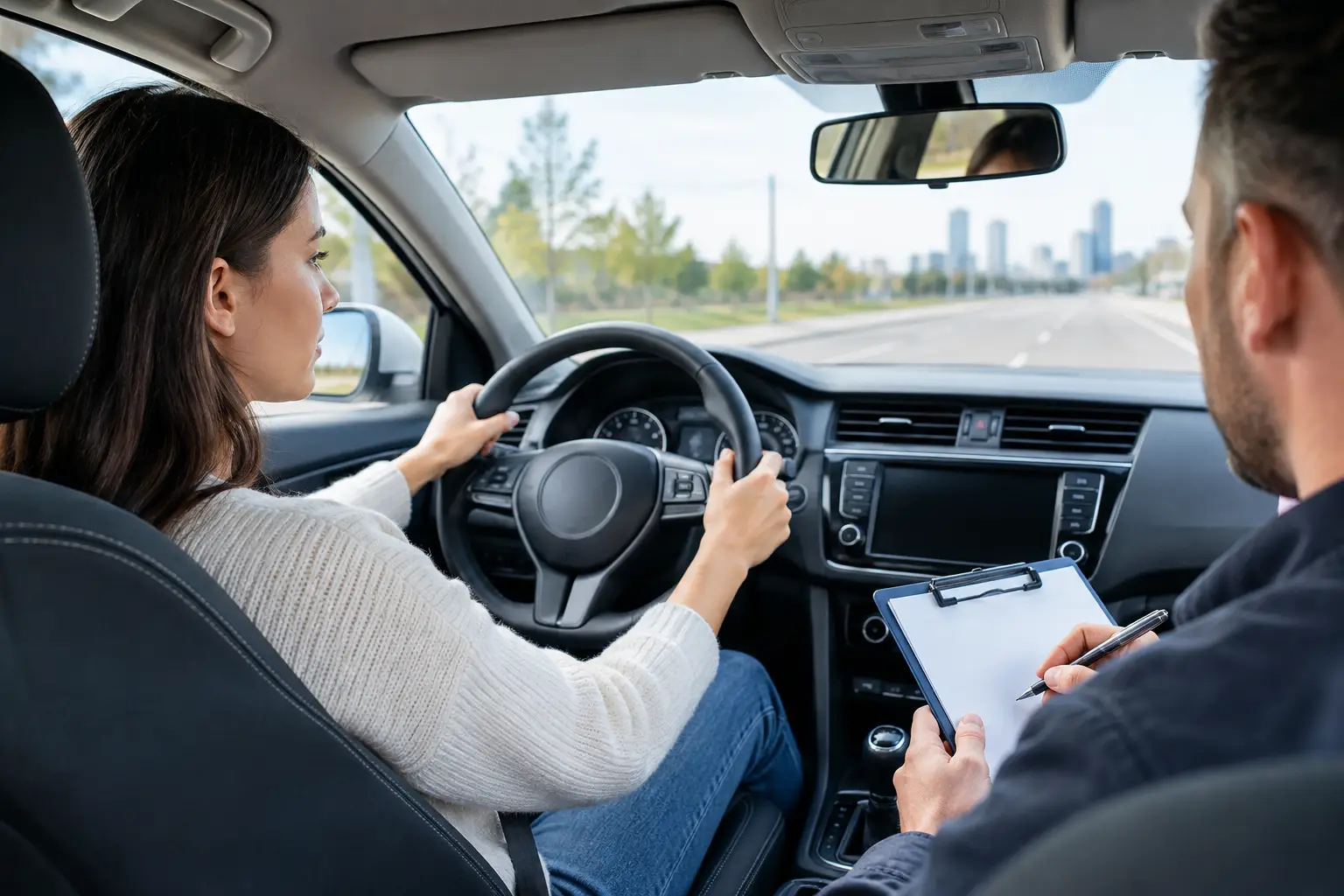
A road test can feel as though every movement is being judged, from the moment you leave the parking space to the final stop. That pressure causes many of the top Alberta road test errors – not because a student does not know the rule, but because they rush, miss an observation, or let nerves interrupt a routine they normally perform well.
The Class 5 road test is designed to assess whether you can drive safely, independently, and predictably in real traffic. The examiner is looking for sound judgment, consistent vehicle control, awareness of other road users, and respect for Alberta traffic laws. A single small mistake is not always the end of a test. Repeated errors, dangerous decisions, or actions that require an examiner to intervene are far more serious.
The most effective preparation is not memorizing a route. It is building repeatable driving habits that still work when you are nervous.
Top Alberta Road Test Errors That Cost Drivers Marks
Incomplete observation at intersections and lane changes
Many students look toward a stop sign, traffic light, or lane marking and assume they have completed an observation. That is not enough. Before entering an intersection, you need a deliberate scan for vehicles, pedestrians, cyclists, and changing traffic conditions. At a stop sign, come to a full stop, then scan left, center, and right before proceeding. Continue checking as you enter if visibility is limited.
Lane changes require the same discipline. Signal early, check the rearview mirror, check the side mirror, perform a shoulder check in the direction you are moving, and change lanes only when there is a safe gap. A quick glance is not a shoulder check. Turn your head enough to check the blind spot, while keeping the vehicle steady.
Students often lose marks when they signal and move immediately, especially near a turn or busy intersection. Give yourself time. Signal, observe, decide, then move. This sequence shows control rather than hesitation.
Rolling stops and poor stop position
A rolling stop is one of the most preventable road test mistakes. Your wheels must come to a complete stop at the correct location. If there is a clearly marked stop line, stop before it. If there is no line, stop before the crosswalk. If neither is present, stop before entering the intersection where you can safely see approaching traffic.
Stopping too far back can also create a problem if it prevents you from seeing cross traffic or pedestrians. In some locations, you may need to stop first, then creep forward carefully for a better view. The key is to make the first stop complete and legal, then move only as needed to improve visibility.
Practice identifying stop lines and crosswalks before test day. This matters in neighborhoods, at railway crossings, and at intersections partially blocked by parked vehicles or snowbanks.
Speed control that does not match conditions
Driving under the posted speed limit is not automatically safer if you are holding up traffic without reason. Driving over the limit, even briefly, is also a serious concern. Examiners expect you to recognize the posted speed limit and maintain a speed appropriate for traffic, weather, visibility, and road conditions.
A common issue is accelerating too slowly after a turn, then traveling well below the flow of traffic. Another is gaining speed downhill and failing to check the speedometer. Build the habit of checking your speed after turns, lane changes, hills, and changes in road type.
Conditions matter. Calgary roads can change quickly with rain, ice, glare, construction, or heavy traffic. When traction or visibility is reduced, create more following distance and reduce speed smoothly. Do not drive timidly, but do show that you can adjust your driving to the risk in front of you.
Turning into the wrong lane
At most intersections, drivers should turn into the nearest legal lane, then complete a lane change later if necessary. A wide right turn that crosses into the left lane, or a left turn that drifts into an outside lane, can put you in conflict with other traffic.
Set up early by choosing the correct lane before the intersection. Signal in good time, slow smoothly, check for pedestrians and cyclists, and keep your steering controlled through the turn. Avoid cutting corners on left turns or swinging wide before making a right turn.
Your vehicle should finish the turn balanced and centered in its lane. If you need to make another turn soon after, do not force the issue. Complete the first maneuver safely, observe, then change lanes when it is safe and legal.
Common Road Test Errors During Parking and Low-Speed Maneuvers
Parking tasks can feel high-pressure because there is less room for error. Yet they are also where a calm, methodical routine makes the biggest difference.
Relying only on the backup camera
A backup camera is useful, but it does not replace direct observation. Before reversing, check around the vehicle, use your mirrors, and look over your right shoulder through the rear window as you back up. Continue scanning because pedestrians, vehicles, and cyclists can enter the area quickly.
During a parallel park, do not stare only at the camera or one mirror. Use your reference points, move slowly, and make small steering corrections. Touching a curb may be assessed differently depending on the situation, but striking a curb hard, mounting it, or creating a hazard is avoidable when you keep the maneuver slow and controlled.
Rushing a parallel park or hill park
Students often rush because they believe the examiner expects one perfect movement. A safe correction is better than forcing the vehicle into a poor position. If there is room and it is safe, straighten the vehicle carefully. Keep watching for traffic and avoid excessive adjustments.
For hill parking, your wheel direction matters. The correct position depends on whether you are uphill or downhill and whether a curb is present. Apply the parking brake, secure the vehicle, and check your surroundings before pulling back into traffic. This is a good skill to practice until the wheel position becomes automatic, not something to guess at during the test.
Losing awareness while reversing
Backing up is not only a steering task. It is an observation task. Before moving, signal if appropriate, check mirrors, perform a shoulder check, and look behind you. Reverse slowly enough that you can stop if someone appears. Keep the vehicle on a predictable path and avoid relying on luck when pulling out of a parking stall or driveway.
Judgment Errors That Matter More Than Perfect Steering
Following too closely
Tailgating reduces your time to recognize and respond to a problem. Leave a safe space behind the vehicle ahead, then increase that space in rain, snow, darkness, congestion, or when following a large vehicle that blocks your view.
A useful following-distance habit is to select a fixed object ahead and count after the vehicle in front passes it. If you reach that object too quickly, ease off the accelerator and rebuild space. This gives you more time to brake gradually instead of reacting late.
Failing to anticipate pedestrians, cyclists, and hazards
The safest drivers do not wait for a hazard to become urgent. They scan ahead and ask what could change next. A pedestrian near a crosswalk may step out. A parked vehicle may open a door. A ball rolling into the street may mean a child is nearby. A vehicle waiting to turn may block your path.
On a road test, show this awareness by adjusting early. Ease off the accelerator when approaching uncertainty, cover the brake when appropriate, and leave space. Defensive driving is not about being overly cautious at every moment. It is about recognizing risk early enough to make calm decisions.
Letting nerves create hesitation or unsafe decisions
Some hesitation is reasonable. Waiting for a safe gap before turning left is responsible driving. The problem begins when a driver waits through several safe opportunities, stops unexpectedly, or enters traffic after becoming impatient.
Use a decision process: observe, identify the risk, choose a safe gap, and commit smoothly. If the gap is not safe, wait without apologizing for it. If it is safe, accelerate with purpose so you do not disrupt traffic. Predictable driving is easier for everyone around you to understand.
How to Prepare for Your Class 5 Road Test
Practice should look like the test you are preparing to take. Include residential roads, major intersections, parking lots, lane changes, school and playground zones when applicable, and varying traffic levels. Do not spend every lesson repeating the same familiar route.
Before your test, run a focused pre-test routine. Adjust your seat, mirrors, and steering wheel so you can operate the controls comfortably. Know where the defroster, lights, wipers, parking brake, and hazard lights are located. Start with a clean windshield and adequate fuel. If you are using your own vehicle, make sure it is safe, insured, and operating properly.
A structured lesson with an Alberta-licensed instructor can identify habits that are easy to miss when practicing with family or friends. At Turn by Turn Driving School, road test preparation focuses on the same skills that matter after test day: observation, hazard detection, control, and responsible decisions in real traffic.
On the day of your test, give yourself extra time to arrive, breathe, and settle into the vehicle. Then drive one intersection at a time. A calm, consistent routine will carry you farther than trying to perform perfectly.
Comments are closed